Market Overview
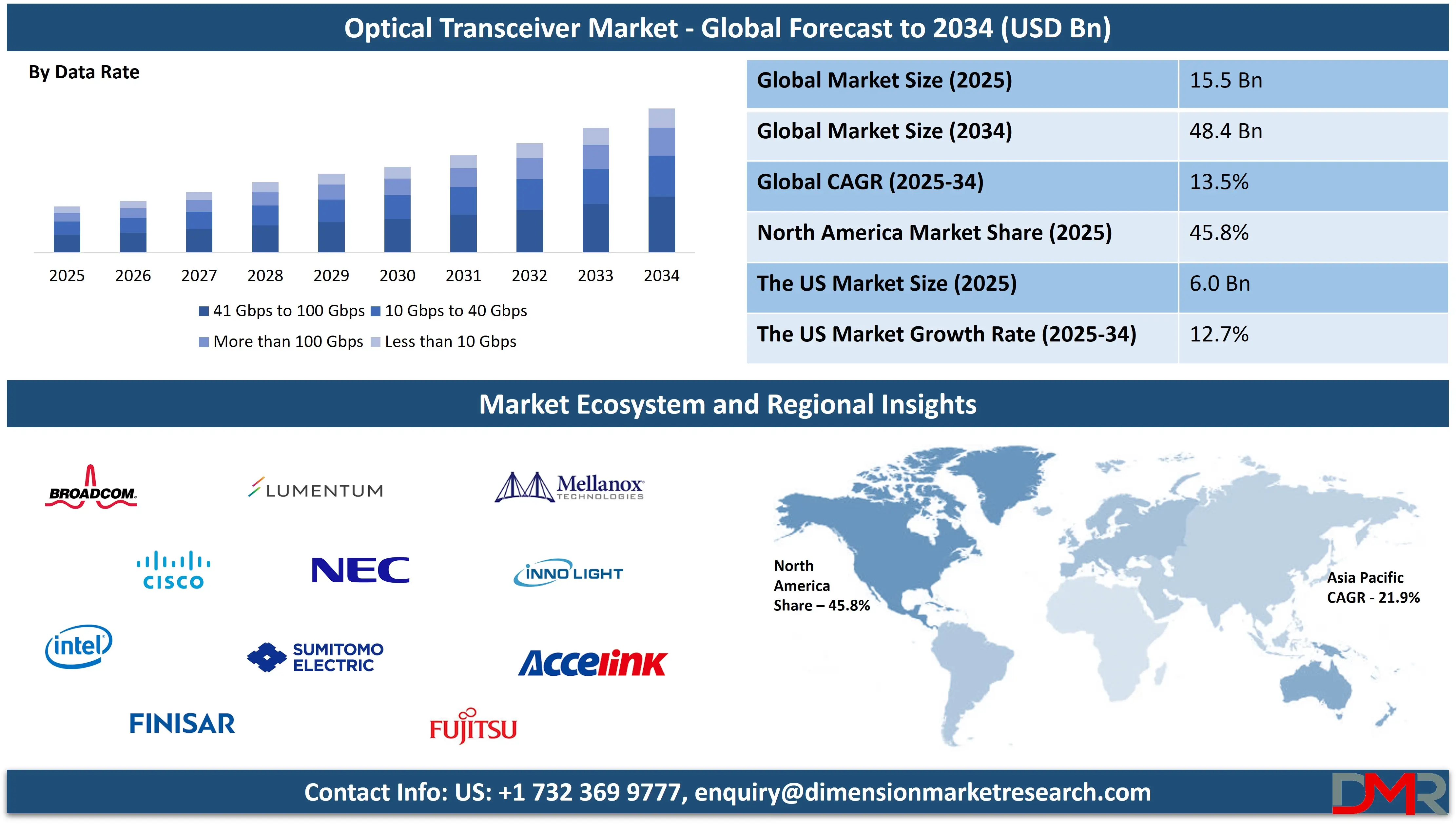
The Global Optical Transceiver Market is estimated to be valued at USD 15.5 billion in 2025 and is further anticipated to reach USD 48.4 billion by 2034 at a CAGR of 13.5%.
ℹ
To learn more about this report –
Download Your Free Sample Report Here
The global Optical Transceiver Market is experiencing strong technological advancement as hyperscale data centers, artificial intelligence infrastructure, cloud computing, and telecommunications networks increase demand for higher-speed optical connectivity. Optical transceivers convert electrical signals into optical signals and enable efficient data transmission across short-reach, metro, and long-haul fiber networks. The industry is witnessing a significant shift toward 400G, 800G, and emerging 1.6T solutions, supported by investments in advanced photonics, high-speed optical components, and energy-efficient network architectures.
Growing deployment of AI computing clusters is accelerating demand for high-bandwidth optical modules capable of supporting dense server and switch interconnections. Meanwhile, coherent optical technologies, next-generation digital signal processors, and advanced optical packaging are expanding opportunities across data center interconnect and telecommunications applications. As manufacturers increase production capabilities and improve power efficiency, the market is expected to benefit from continued infrastructure investment, although component availability, pricing pressure, and technology transitions will influence its future growth trajectory.

ℹ
To learn more about this report –
Download Your Free Sample Report Here
The US Optical Transceiver Market
The U.S. Optical Transceiver Market is projected to be valued at USD 6.0 billion in 2025. It is further expected to witness subsequent growth in the upcoming period, holding USD 17.5 billion in 2034 at a CAGR of 12.7%.

ℹ
To learn more about this report –
Download Your Free Sample Report Here
The U.S. optical transceiver market is a mature yet rapidly evolving segment, largely fueled by the country’s advanced digital infrastructure and the continuous demand for high-speed, low-latency connectivity. With the proliferation of cloud computing, 5G rollouts, and AI-driven applications, the need for scalable, high-bandwidth optical communication systems has intensified. U.S.-based hyperscale data center operators, telecom giants, and content delivery networks are leading adopters of optical transceivers, utilizing them to handle the surging volume of data traffic and ensure network reliability.
The presence of major cloud service providers like Amazon Web Services, Google Cloud, and Microsoft Azure further amplifies the demand for next-generation transceiver solutions that support dense and high-throughput networking environments.
Government initiatives and private-sector investment are supporting the development of optical communications infrastructure across the United States. The Broadband Equity, Access, and Deployment (BEAD) Program provides a framework for expanding high-speed internet access in underserved and unserved communities, creating potential demand for fiber-optic networking equipment and associated optical transceiver technologies. Meanwhile, continued investment in hyperscale data centers, artificial intelligence infrastructure, and advanced telecommunications networks is encouraging the adoption of higher-capacity optical connectivity solutions. These developments support opportunities for optical component manufacturers, networking equipment suppliers, and technology providers serving the U.S. market.
Europe Optical Transceiver Market
The Europe Optical Transceiver Market is supported by continued investment in fiber broadband infrastructure, cloud computing, telecommunications modernization, and data center connectivity. Countries such as Germany, the United Kingdom, France, and the Netherlands are important markets for advanced optical networking solutions, with increasing requirements for high-capacity transmission across enterprise, metropolitan, and inter-data-center networks. The expansion of AI infrastructure and demand for low-latency communications are encouraging the adoption of 400G, 800G, and next-generation optical technologies.
European telecommunications operators and data center providers are focusing on energy efficiency, scalable network architectures, and advanced optical transmission systems to support growing data traffic. Investments in coherent optics, wavelength-division multiplexing, and integrated photonic technologies are creating opportunities for optical component suppliers and transceiver manufacturers. As digital infrastructure continues to expand, the European market is expected to benefit from network modernization, cloud adoption, and the increasing need for reliable, high-bandwidth connectivity.
Japan Optical Transceiver Market
The Japan Optical Transceiver Market is supported by the country's advanced telecommunications infrastructure, growing cloud computing industry, and continued investments in high-speed optical networking technologies. Demand for optical transceivers is increasing across data centers, enterprise networks, telecommunications backbone systems, and metropolitan connectivity infrastructure. The expansion of artificial intelligence applications, high-performance computing, and next-generation mobile communications is encouraging greater adoption of high-bandwidth optical modules.
Japanese technology companies and research institutions contribute to optical communications innovation through developments in photonics, semiconductor technologies, optical components, and advanced networking systems. Increasing demand for 400G, 800G, and emerging 1.6T connectivity solutions is expected to create opportunities across data center infrastructure and telecommunications modernization. Future growth will depend on network capacity upgrades, energy-efficient optical technologies, and continued investment in advanced digital infrastructure.
Global Optical Transceiver Market: Key Takeaways
- Market Value: The global optical transceiver market size is expected to reach a value of USD 48.4 billion by 2034 from a base value of USD 15.5 billion in 2025 at a CAGR of 13.5%.
- By Form Factor Segment Analysis: QSFP, QSFP+, QSFP-DD, QSFP28, and QSFP56 are poised to consolidate their dominance in the form factor segment, capturing 38.8% of the total market share in 2025.
- By Data Rate Segment Analysis: 41 Gbps to 100 Gbps data rate is anticipated to maintain its dominance in the data rate segment, capturing 38.9% of the total market share in 2025.
- By Fiber Type Segment Analysis: Single-Mode Fiber (SMF) is poised to consolidate its market position in the fiber type segment, capturing 68.3% of the total market share in 2025.
- By Distance Segment Analysis: Less than 1 KM distance is expected to maintain its dominance in the distance segment, capturing 47.5% of the total market share in 2025.
- By Wavelength Segment Analysis: 1310 NM Band is expected to maintain its dominance in the wavelength segment, capturing 39.6% of the total market share in 2025.
- By Connector Segment Analysis: LC connectors are poised to consolidate their dominance in the connector segment, capturing 53.7% of the total market share in 2025.
- By Protocol Segment Analysis: Ethernet is anticipated to maintain its dominance in the protocol segment, capturing 57.1% of the total market share in 2025.
- By Application Type Segment Analysis: Telecommunication applications are poised to consolidate their market position in the application type segment, capturing 47.3% of the total market share in 2025.
- Regional Analysis: North America is anticipated to lead the global optical transceiver market landscape with 45.8% of total global market revenue in 2025.
- Key Players: Some key players in the global optical transceiver market are Broadcom, Cisco Systems, Intel Corporation, Finisar (now part of II-VI Incorporated), II-VI Incorporated, Lumentum Holdings, Sumitomo Electric Industries, Fujitsu Optical Components, NEC Corporation, Mellanox Technologies (now part of NVIDIA), Accelink Technologies, InnoLight Technology, Hisense Broadband, Source Photonics, Applied Optoelectronics, Reflex Photonics (acquired by Smiths Interconnect), Huawei Technologies, Ciena Corporation, Viavi Solutions, AOI (Advanced Optoelectronic Technology Inc.), and Other Key Players.
Global Optical Transceiver Market: Stats & Facts
According to LightCounting (June 2026)
- Global sales of optical transceivers and related products reached approximately USD 26.8 billion in 2025, representing 74% year-over-year growth.
- Sales of optical transceivers and active optical cables reached approximately USD 10.0 billion in Q1 2026, increasing by more than 90% compared with Q1 2025.
According to LightCounting (April 2026)
- The Ethernet optical transceiver market recorded 93% growth in 2024, followed by an estimated 82% growth in 2025.
- Ethernet optical transceiver market revenue was forecast to increase by 65% in 2026, supported by rising demand from hyperscale data centers and AI infrastructure.
- Demand for indium phosphide (InP) electro-absorption modulated lasers and related laser chips exceeded available supply by approximately 30% in early 2026.
According to LightCounting (February 2026)
- Shipments of 800G PAM4 chipsets nearly tripled in 2025, while chipset sales more than doubled compared with the previous year.
- Shipments of 800G optical transceivers were projected to more than double in 2026, supported by expanding AI computing clusters.
- Global shipments of 1.6T optical transceivers were expected to reach tens of millions of ports in 2026, increasing from a relatively small base in 2025.
- Sales of 1.6T optical chipsets were projected to exceed USD 2.0 billion in 2026, reflecting increasing adoption of next-generation high-bandwidth optical technologies.
According to LightCounting (September 2026)
- Ethernet optical transceivers accounted for approximately 80% of the total optical transceiver market, reflecting strong demand for high-speed data center connectivity.
- Shipments of selected 800G optical transceiver products and 400ZR/ZR+ modules increased by up to three times year-over-year in Q2 2026.
Global Optical Transceiver Market: Use Cases
- 5G Network Infrastructure Backhaul: As telecom operators continue to roll out 5G globally, optical transceivers play a pivotal role in enabling high-capacity, low-latency data transport between cell sites, base stations, and core networks. The surge in mobile data traffic and real-time application requirements demands robust backhaul solutions. Optical transceivers, especially those using DWDM and coherent optics, are being deployed in metro and long-haul segments to provide the scalable bandwidth 5G networks require.
- Hyperscale Data Center Interconnect (DCI): Hyperscale data centers operated by companies like Amazon, Google, Meta, and Microsoft require efficient interconnects to manage massive data volumes across regional clusters. Optical transceivers are critical in Data Center Interconnect (DCI) applications, enabling point-to-point and point-to-multipoint connections across short (<2 km) to medium (2–80 km) distances.
- Fiber to the Home (FTTH) & Last-Mile Connectivity: Governments and ISPs around the world are investing in fiber broadband infrastructure to bridge the digital divide. Optical transceivers are widely used in FTTH applications, particularly in Optical Line Terminals (OLTs) and Optical Network Units (ONUs). These transceivers enable high-speed internet access directly to homes and businesses, improving digital access in rural and underserved areas.
- High-Speed Trading & Financial Networks: In the financial sector, milliseconds can determine competitive advantage. Optical transceivers are deployed in high-frequency trading (HFT) environments where ultra-low latency and high data throughput are essential. Financial firms use these transceivers to build private networks and ensure direct market access (DMA) to global stock exchanges.
Global Optical Transceiver Market: Market Dynamics
Global Optical Transceiver Market: Driving Factors
Surge in AI and Machine Learning Workloads Driving High-Speed Optical Connectivity
The global expansion of artificial intelligence (AI) and machine learning (ML) workloads is placing unprecedented demand on data infrastructure, directly accelerating the adoption of high-speed optical transceivers. As AI models become more complex and data-hungry, particularly in natural language processing, image recognition, and autonomous systems, the volume of data that needs to be processed, transferred, and stored across distributed computing environments has skyrocketed. Optical transceivers capable of supporting 200G, 400G, and even 800G are becoming essential components in high-performance computing (HPC) clusters and hyperscale cloud data centers.
Government-Led Digital Infrastructure Initiatives and Broadband Expansion
Across developed and emerging economies, government initiatives to modernize digital infrastructure and expand broadband access are significantly contributing to the optical transceiver market’s growth. Programs such as the U.S. Broadband Equity, Access, and Deployment (BEAD) initiative, the EU’s Digital Decade targets, and Asia-Pacific’s Smart Nation projects are injecting billions of dollars into fiber network deployments, particularly in underserved rural and suburban areas. Optical transceivers are the backbone of these projects, powering the high-speed transmission of data from central offices to homes, schools, healthcare centers, and businesses through FTTx architectures.
Global Optical Transceiver Market: Restraints
Supply Chain Disruptions and Raw Material Volatility
The complex manufacturing ecosystem of optical transceivers, which involves suppliers across the U.S., Asia-Pacific, and Europe, makes the market highly vulnerable to geopolitical tensions, trade restrictions, and logistic delays. Events like the global semiconductor shortage, COVID-19-related factory shutdowns, and regional conflicts (e.g., U.S.-China tech restrictions) have all contributed to delayed production cycles, lead times, and rising costs. Moreover, raw material price volatility, especially for rare earth elements and specialized glass used in photonic components, puts financial strain on manufacturers and limits their ability to scale cost-effectively.
Interoperability Challenges and Lack of Standardization Across Vendors
Many large-scale deployments, particularly in data centers and telecom networks, use equipment from multiple vendors. However, the lack of universal standards in transceiver design, firmware compatibility, and form factor specifications often leads to integration problems. Customization needs and proprietary firmware restrictions can create vendor lock-in situations, reducing flexibility and operational complexity for network administrators. Additionally, newer high-speed transceivers (e.g., 400G, 800G) frequently require upgraded infrastructure, such as specific connectors, new cooling mechanisms, or power supply enhancements, which may not be backward-compatible with existing setups.
Global Optical Transceiver Market: Opportunities
Emergence of Co-Packaged Optics (CPO) as a Next-Generation Integration Paradigm
Co-Packaged Optics (CPO) represents a significant opportunity in the global Optical Transceiver Market as hyperscale data centers and artificial intelligence infrastructure demand higher bandwidth, improved power efficiency, and reduced signal transmission losses. By integrating optical engines closer to high-performance switching and processing chips, CPO reduces electrical interconnect distances and helps address power consumption and signal integrity challenges associated with conventional high-speed electrical connections. The technology is gaining attention as network architectures transition toward 800G, 1.6T, and higher-capacity optical connectivity.
Industry participants are investing in silicon photonics, advanced packaging, optical engines, and interoperability standards to support the development of scalable CPO solutions. Although conventional pluggable optical transceivers remain important across existing network deployments, CPO offers opportunities for next-generation high-density computing environments. Its broader commercialization will depend on manufacturing scalability, thermal management, serviceability, and compatibility with evolving data center architectures.
Growing Adoption of Green Data Centers and Energy-Efficient Network Architectures
Optical transceivers inherently consume less power than copper-based alternatives for equivalent bandwidth, and new designs are emerging with advanced modulation techniques and photonic integration to further reduce energy usage. Governments, cloud providers, and hyperscale operators are setting ambitious targets to reduce data center carbon footprints, driving demand for energy-efficient transceivers such as 100G QSFP28, 400G QSFP-DD, and future 800 G+ form factors optimized for lower power per bit. In addition, transceivers supporting intelligent monitoring, thermal management, and adaptive optics are gaining traction as enterprises seek to align with global ESG (Environmental, Social, and Governance) goals.
Global Optical Transceiver Market: Trends
Shift toward Higher-Speed Transceivers for Cloud and Edge Computing
With cloud service providers like Amazon Web Services (AWS), Microsoft Azure, and Google Cloud expanding their global infrastructure, the demand for high-speed, low-latency optical transceivers (ranging from 100G to 800G and beyond) is on the rise. These transceivers, particularly in QSFP-DD, OSFP, and emerging 800G formats, enable seamless data transfer between geographically dispersed data centers, ensuring minimal latency for mission-critical applications such as real-time analytics, AI training, and virtual collaboration. Additionally, edge computing, which places computational resources closer to end-users to reduce latency and improve performance, requires high-throughput, low-latency connectivity between edge data centers and the core cloud.
Integration of AI and Machine Learning into Network Management for Optical Systems
As networks become more complex with the growing deployment of high-speed optical transceivers, network operators are turning to AI-driven platforms to optimize performance, automate troubleshooting, and predict equipment failures. By leveraging AI/ML algorithms, these platforms can analyze vast amounts of data from transceivers and network devices in real time, allowing for predictive maintenance, dynamic bandwidth allocation, and proactive fault management. For example, AI-based optical network optimization can enable adaptive modulation and power-saving modes in transceivers based on traffic patterns, reducing operational costs while maximizing network uptime.
Global Optical Transceiver Market: Research Scope and Analysis
By Form Factor Analysis
The QSFP, QSFP+, QSFP-DD, QSFP28, and QSFP56 form factors are expected to hold a dominant position in the optical transceiver market, capturing an estimated 38.8% of the total market share in 2025. This growth is driven by the rising demand for high-speed, high-density solutions in environments such as data centers, telecommunications, and enterprise networks. These form factors, especially QSFP28 and QSFP56, are ideal for ultra-high-speed optical transceivers, typically supporting speeds from 25G to 400G and beyond.

ℹ
To learn more about this report –
Download Your Free Sample Report Here
Their compact size and ability to support multiple lanes of data transfer make them ideal for high-bandwidth, space-constrained environments, where density and performance are paramount. The QSFP family of form factors offers scalability and flexibility, which makes them the preferred choice in cloud data centers and hyperscale networks, where efficiency and speed are critical. Moreover, the transition to 400G Ethernet and 800G optics has driven the growth of QSFP-DD (Double Density) transceivers, offering higher data rates while maintaining compatibility with existing infrastructure.
On the other hand, the CFP, CFP2, CFP4, and CFP8 form factors, while not as dominant as the QSFP family, are critical players in specific niches of the optical transceiver market. These form factors are primarily used in high-capacity, long-distance applications, including telecommunication networks and high-performance computing (HPC) setups. The CFP (C form-factor pluggable) family was initially designed for 100G Ethernet and has evolved to include CFP2, CFP4, and CFP8 to meet the growing demand for higher-speed optical transmission. Each successive generation in the CFP family offers a more compact form factor while maintaining high data rate capabilities, such as 400G and beyond, making them well-suited for large-scale, high-capacity network backbones.
By Data Rate Analysis
The 41 Gbps to 100 Gbps data rate segment is projected to retain its leading position in the optical transceiver market, capturing an estimated 38.9% of the total market share in 2025. This dominance is driven by the ongoing demand for high-speed connectivity in critical applications such as data centers, telecommunications, and cloud services. Transceivers within this data rate range, such as 100G Ethernet and 100G optical transport, are crucial for supporting high-bandwidth applications like real-time data processing, AI workloads, and big data analytics.
As enterprises, service providers, and cloud vendors scale their infrastructure, the need for faster data transmission and greater capacity becomes vital to meet the growing volume of data being generated and consumed globally. The 100G optical transceivers, such as those based on QSFP28 and QSFP56 form factors, are particularly important for high-throughput networking. These transceivers provide reliable and efficient solutions for applications like server-to-server communication, backbone networking, and interconnects between data centers.
On the other hand, the 10 Gbps to 40 Gbps data rate segment plays an essential role in the market, catering to applications where lower but still substantial data rates are sufficient. Transceivers in this range, such as 10G and 40G Ethernet, continue to serve a wide range of applications, including enterprise networks, smaller-scale data centers, and telecommunications. These data rates provide a balance between performance and cost, making them attractive for businesses and service providers that need robust networking capabilities without the higher price tag of 100G solutions. The 10 Gbps to 40 Gbps segment also benefits from the ongoing migration of network infrastructures, as businesses look to upgrade from older, slower systems to more efficient solutions that support modern network demands.
By Fiber Type Analysis
Single-Mode Fiber (SMF) is expected to dominate the Optical Transceiver Market with a 68.3% share in 2025, supported by its widespread deployment across telecommunications, data centers, and high-capacity optical networks. SMF enables reliable data transmission over short, intermediate, and long distances with low signal attenuation and minimal modal dispersion. Increasing adoption of 400G, 800G, and emerging 1.6T optical transceivers is strengthening demand across hyperscale data centers and telecommunications infrastructure. Its compatibility with advanced optical technologies also supports scalable network expansion.
Meanwhile, Multimode Fiber (MMF) remains important for short-distance applications within enterprise networks, campus environments, and data centers. Its cost-effective deployment and compatibility with VCSEL technologies support high-speed connectivity over limited distances, particularly where infrastructure costs and installation flexibility are important.
By Distance Analysis
The Less than 1 KM segment is projected to dominate the Optical Transceiver Market with a 47.5% share in 2025, driven by increasing demand for short-reach optical connectivity across hyperscale data centers, enterprise networks, and telecommunications facilities. These transceivers enable high-speed communication between servers, switches, storage systems, and networking equipment within closely connected infrastructure. Growing adoption of artificial intelligence, cloud computing, and high-performance computing is accelerating demand for 400G, 800G, and emerging 1.6T optical solutions.
Both single-mode and multimode fiber technologies support short-reach applications, depending on bandwidth, distance, and network architecture. Meanwhile, transceivers operating beyond 1 KM remain essential for metropolitan networks, inter-data-center connectivity, and telecommunications backbone infrastructure requiring reliable optical transmission over extended distances and greater network coverage.
By Wavelength Analysis
The 1310 nm band is expected to account for 39.6% of the global Optical Transceiver Market's wavelength segment in 2025, positioning it as the dominant wavelength category. This leadership is primarily attributed to its extensive use in short- and intermediate-reach optical communication networks, including data centers, enterprise networks, metropolitan infrastructure, and telecommunications access systems. The 1310 nm wavelength operates within the second optical transmission window and offers relatively low chromatic dispersion in standard single-mode fiber, making it suitable for reliable, high-speed data transmission. It is commonly deployed in optical transceivers supporting transmission distances of up to 10 km, with certain specialized solutions enabling longer reaches. Its compatibility with widely adopted Ethernet standards, cost-effective implementation, and ability to support increasing bandwidth requirements contribute to its strong market position.
The 1310 nm wavelength plays an important role in data center interconnects, enterprise connectivity, and metropolitan telecommunications networks, where efficient optical transmission and signal integrity are essential. Growing adoption of 100G, 400G, and 800G optical transceivers is supporting demand for advanced 1310 nm solutions, particularly in high-density computing environments and cloud infrastructure. Additionally, improvements in laser technologies, optical modulation, and photonic integration are enhancing transmission performance and energy efficiency. Although the 1310 nm band supports selected extended-reach applications, it is primarily associated with short- and intermediate-distance communications rather than conventional long-haul transmission systems.
Meanwhile, the 1550 nm band is expected to maintain a significant presence in the Optical Transceiver Market due to its lower fiber attenuation and suitability for long-distance, high-capacity optical transmission. This wavelength is widely used in telecommunications backbone networks, metropolitan and long-haul infrastructure, data center interconnects, and submarine communication systems. The 1550 nm band supports optical amplification using erbium-doped fiber amplifiers (EDFAs), enabling signals to travel over extended distances without frequent electrical regeneration.
By Connector Analysis
The LC connector segment is expected to dominate the Optical Transceiver Market with a 53.7% share in 2025, supported by its compact design, reliable performance, and widespread deployment across telecommunications networks, enterprise infrastructure, and data centers. Its smaller footprint enables higher connection density, making it suitable for space-constrained networking equipment and various SFP and QSFP-based optical modules. Growing adoption of cloud computing, 5G infrastructure, and high-speed optical networks continues to strengthen demand for LC-compatible connectivity solutions.
Meanwhile, SC connectors maintain a significant presence in fiber broadband, telecommunications access networks, and enterprise applications due to their durability and convenient push-pull installation. Advanced connectors, including MPO/MTP, CS, and SN, are also gaining importance as data centers increasingly require high-density fiber connections and efficient cable management.
By Protocol Analysis
Ethernet is expected to dominate the Optical Transceiver Market with a 57.1% share in 2025, supported by its extensive adoption across enterprise networks, telecommunications infrastructure, hyperscale data centers, and cloud computing environments. Its scalability, standardized architecture, and compatibility with high-speed networking equipment make Ethernet a preferred solution for reliable data transmission. Increasing deployment of 100G, 400G, 800G, and emerging 1.6T Ethernet technologies is accelerating demand for advanced optical transceivers across bandwidth-intensive applications.
Meanwhile, Fibre Channel maintains an important position in specialized storage area networks requiring reliable, low-latency data transmission. Its dedicated storage networking capabilities support enterprise data centers, financial institutions, and mission-critical applications. Growing demand for high-performance storage infrastructure and data-intensive enterprise operations continues to support Fibre Channel optical transceiver deployment.
By Application Analysis
Telecommunication applications are expected to dominate the Optical Transceiver Market with a 47.3% share in 2025, supported by expanding 5G infrastructure, fiber broadband deployment, and telecommunications network modernization. Optical transceivers enable high-capacity data transmission across access, metropolitan, and backbone networks, supporting reliable communication between network facilities and connected infrastructure. Increasing demand for high-speed internet, mobile data services, and network capacity upgrades continues to strengthen telecommunications applications.
Meanwhile, data center applications are experiencing significant growth due to expanding artificial intelligence workloads, cloud computing, and hyperscale infrastructure investments. Growing adoption of 400G, 800G, and emerging 1.6T optical technologies is increasing demand for high-bandwidth, low-latency connectivity between servers, switches, and storage systems, supporting efficient data processing and scalable networking operations worldwide.
The Optical Transceiver Market Report is segmented on the basis of the following
By Form Factor
- SFF and SFP
- SFP+ and SFP28
- QSFP, QSFP+, QSFP-DD, QSFP28, and QSFP56
- CFP, CFP2, CFP4, and CFP8
- XFP
- CXP
By Data Rate
- Less than 10 GBPS
- 10 GBPS to 40 GBPS
- 41 GBPS to 100 GBPS
- More than 100 GBPS
By Fiber Type
- Single-Mode Fiber (SMF)
- Multimode Fiber (MMF)
By Distance
- Less than 1 KM
- 1 to 10 KM
- 11 to 100 KM
- More than 100 KM
By Wavelength
- 850 NM Band
- 1310 NM Band
- 1550 NM Band
- Other Wavelengths
By Connector
By Protocol
- Ethernet
- Fiber Channels
- CWDM/DWDM
- FTTX
- Other Protocols
By Application
- Telecommunication
- Data Center
- Enterprise
Global Optical Transceiver Market: Regional Analysis
Region with the Largest Revenue Share
North America is projected to lead the global optical transceiver market in 2025, accounting for 45.8 percent of the total global market revenue. This strong regional dominance is underpinned by a combination of mature infrastructure, aggressive adoption of next-generation technologies, and the presence of major industry players. The region is home to some of the world’s largest cloud service providers, data center operators, and telecommunications companies, all of which continuously invest in upgrading their network capabilities to handle the surge in data traffic and connectivity demands.
These investments directly drive the demand for advanced optical transceivers, which serve as the critical interface for high-speed data transfer across fiber networks. The expansion of 5G infrastructure across the United States and Canada is a key catalyst for market growth. As telecom operators build out their 5G networks, they require high-performance transceivers capable of supporting low-latency, high-bandwidth communication across various network segments, including metro, access, and long-haul.

ℹ
To learn more about this report –
Download Your Free Sample Report Here
Region with significant growth
Asia Pacific is expected to record the highest compound annual growth rate (CAGR) in the global optical transceiver market over the forecast period. This rapid growth is largely driven by the region’s ongoing digital transformation, widespread deployment of high-speed broadband infrastructure, and investments in 5G, cloud computing, and data center expansion. Countries such as China, India, Japan, South Korea, and Southeast Asian nations are witnessing a significant surge in internet penetration and mobile device usage, which in turn drives the demand for robust and scalable network infrastructure supported by high-performance optical transceivers. One of the key factors behind the region’s strong growth trajectory is the large-scale rollout of 5G networks, particularly in China and South Korea, where government-led initiatives and public-private partnerships are accelerating infrastructure upgrades.
By Region
North America
Europe
- Germany
- The U.K.
- France
- Italy
- Russia
- Spain
- Benelux
- Nordic
- Rest of Europe
Asia-Pacific
- China
- Japan
- South Korea
- India
- ANZ
- ASEAN
- Rest of Asia-Pacific
Latin America
- Brazil
- Mexico
- Argentina
- Colombia
- Rest of Latin America
Middle East & Africa
- Saudi Arabia
- UAE
- South Africa
- Israel
- Egypt
- Rest of MEA
Global Optical Transceiver Market: Competitive Landscape
The global Optical Transceiver Market features a competitive landscape comprising optical module manufacturers, photonics technology developers, networking equipment providers, and semiconductor companies. Prominent participants include Coherent Corporation, Lumentum Holdings, Eoptolink Technology, InnoLight Technology, Accelink Technologies, Applied Optoelectronics, and Hisense Broadband, alongside major technology providers such as Broadcom, Marvell Technology, Cisco Systems, and NVIDIA. Companies are increasingly focusing on high-speed 400G, 800G, and 1.6T optical solutions to address the rising bandwidth requirements of artificial intelligence, hyperscale data centers, telecommunications networks, and cloud infrastructure. Strategic investments in silicon photonics, coherent optics, optical digital signal processors, and advanced packaging technologies are strengthening competitive differentiation. Partnerships, product innovation, and manufacturing scalability remain central to market positioning as demand shifts toward higher-performance and more energy-efficient optical connectivity solutions.
Some of the prominent players in the Global Optical Transceiver market are
- Coherent Corporation
- Broadcom Inc.
- Cisco Systems, Inc.
- Lumentum Holdings Inc.
- Eoptolink Technology Inc., Ltd.
- InnoLight Technology (Suzhou) Ltd.
- Accelink Technologies Co., Ltd.
- Applied Optoelectronics, Inc.
- Fabrinet
- Marvell Technology, Inc.
- Hisense Broadband Multimedia Technologies Co., Ltd.
- HG Genuine
- Sumitomo Electric Industries, Ltd.
- Source Photonics
- NVIDIA Corporation
- Huawei Technologies Co., Ltd.
- Ciena Corporation
- Fujitsu Limited
- Intel Corporation
- Other Key Players
Global Optical Transceiver Market: Recent Developments
- In March 2026, Coherent Corporation announced demonstrations of next-generation optical technologies at OFC 2026, including 1.6T optical transceivers, 3.2T optical link technologies, and emerging 12.8T architectures. These developments support higher-bandwidth connectivity in hyperscale AI data centers and next-generation optical networking infrastructure.
- In March 2026, Lumentum Holdings demonstrated advanced photonic technologies at OFC 2026, including a 1.6T DR4 OSFP optical transceiver prototype incorporating four 400G differential electro-absorption modulated lasers. The development focuses on improving data transmission capacity and supporting future high-density AI networking requirements.
- In March 2026, Marvell Technology expanded its 1.6T optical digital signal processor portfolio with Ara T, Ara X, Petra, and Aquila M technologies. The product expansion focuses on improved energy efficiency, signal reliability, high-speed connectivity, and secure optical communications in next-generation AI data centers.
- In March 2026, Marvell Technology introduced its COLORZ 1600, a 1.6T ZR/ZR+ coherent optical transceiver powered by its Electra digital signal processor. The company also presented its second-generation COLORZ 800 platform to address high-capacity data center interconnect and secure optical networking applications.
- In March 2026, Eoptolink Technology introduced a 12.8T XPO liquid-cooled pluggable optical transceiver designed for high-density AI networking systems. The product integrates 64 optical lanes operating at 200 Gbps and incorporates thermal management technology to support next-generation high-bandwidth data center architectures.
- In September 2025, Ciena Corporation announced a definitive agreement to acquire Nubis Communications, a U.S.-based developer of high-performance optical and electrical interconnect technologies. The proposed acquisition was intended to strengthen Ciena's capabilities in co-packaged optics, near-packaged optics, and high-density AI data center connectivity.
- In March 2025, Eoptolink Technology introduced its 1.6T OSFP 2VR4 optical transceiver at OFC 2025, utilizing 200G vertical-cavity surface-emitting laser technology. The module was designed to deliver 1.6 Tbps connectivity over multimode fiber and support higher bandwidth requirements in hyperscale data center infrastructure.
Report Details
|
Report Characteristics
|
| Market Size (2025) |
USD 15.5 Bn |
| Forecast Value (2034) |
USD 48.4 Bn |
| CAGR (2025-2034) |
13.5% |
| Historical Data |
2019 – 2024 |
| The US Market Size (2025) |
USD 6.0 Bn |
| Forecast Data |
2025 – 2033 |
| Base Year |
2024 |
| Estimate Year |
2025 |
| Report Coverage |
Market Revenue Estimation, Market Dynamics, Competitive Landscape, Growth Factors and etc. |
| Segments Covered |
By Form Factor (SFF and SFP, SFP+ and SFP28, QSFP, QSFP+, QSFP-DD, QSFP28, and QSFP56, CFP, CFP2, CFP4, and CFP8, XFP, CXP), By Data Rate (Less than 10 Gbps, 10 Gbps to 40 Gbps, 41 Gbps to 100 Gbps, More than 100 Gbps), By Fiber Type (Single-Mode Fiber (SMF), Multimode Fiber (MMF)), By Distance (Less than 1 KM, 1 to 10 KM, 11 to 100 KM, More than 100 KM), By Wavelength (850 NM Band, 1310 NM Band, 1550 NM Band, Other Wavelengths), By Connector (LC, SC, MPO, RJ-45), and By Protocol (Ethernet, Fiber Channels, CWDM/DWDM, FTTX, Other Protocols), By Application (Telecommunication, Data Center, Enterprise) |
| Regional Coverage |
North America – The US and Canada; Europe – Germany, The UK, France, Russia, Spain, Italy, Benelux, Nordic, & Rest of Europe; Asia- Pacific– China, Japan, South Korea, India, ANZ, ASEAN, Rest of APAC; Latin America – Brazil, Mexico, Argentina, Colombia, Rest of Latin America; Middle East & Africa – Saudi Arabia, UAE, South Africa, Turkey, Egypt, Israel, & Rest of MEA |
| Prominent Players |
Broadcom, Cisco Systems, Intel Corporation, Finisar (now part of II-VI Incorporated), II-VI Incorporated, Lumentum Holdings, Sumitomo Electric Industries, Fujitsu Optical Components, NEC Corporation, Mellanox Technologies (now part of NVIDIA), Accelink Technologies, InnoLight Technology, Hisense Broadband, Source Photonics, Applied Optoelectronics, Reflex Photonics (acquired by Smiths Interconnect), Huawei Technologies, Ciena Corporation, Viavi Solutions, AOI (Advanced Optoelectronic Technology Inc.), and Other Key Players |
| Purchase Options |
We have three licenses to opt for: Single User License (Limited to 1 user), Multi-User License (Up to 5 Users) and Corporate Use License (Unlimited User) along with free report customization equivalent to 0 analyst working days, 3 analysts working days and 5 analysts working days respectively. |
Frequently Asked Questions
How big is the global Optical Transceiver market?
▾ The global Optical Transceiver market size is estimated to have a value of USD 15.5 billion in 2025 and is expected to reach USD 48.4 billion by the end of 2034.
What is the size of the US Optical Transceiver market?
▾ The US Optical Transceiver market is projected to be valued at USD 6.0 billion in 2025. It is expected to witness subsequent growth in the upcoming period as it holds USD 17.5 billion in 2034 at a CAGR of 12.7%.
Which region accounted for the largest global Optical Transceiver market?
▾ North America is expected to have the largest market share in the global Optical Transceiver market, with a share of about 45.8% in 2025.
Who are the key players in the global Optical Transceiver market?
▾ Some of the major key players in the global Optical Transceiver Market are Coherent Corporation (including Finisar and the former II-VI Incorporated), Broadcom Inc., Cisco Systems, Inc., Intel Corporation, Lumentum Holdings Inc., Sumitomo Electric Industries, Ltd., Fujitsu Limited, NEC Corporation, NVIDIA Corporation (including Mellanox Technologies), Accelink Technologies Co., Ltd., InnoLight Technology (Suzhou) Ltd., Eoptolink Technology Inc., Ltd., Hisense Broadband Multimedia Technologies Co., Ltd., Source Photonics, Applied Optoelectronics, Inc., Huawei Technologies Co., Ltd., Ciena Corporation, Marvell Technology, Inc., Fabrinet, HG Genuine, and Other Key Players.
What is the growth rate of the global Optical Transceiver market?
▾ The market is growing at a CAGR of 13.5 percent over the forecasted period.