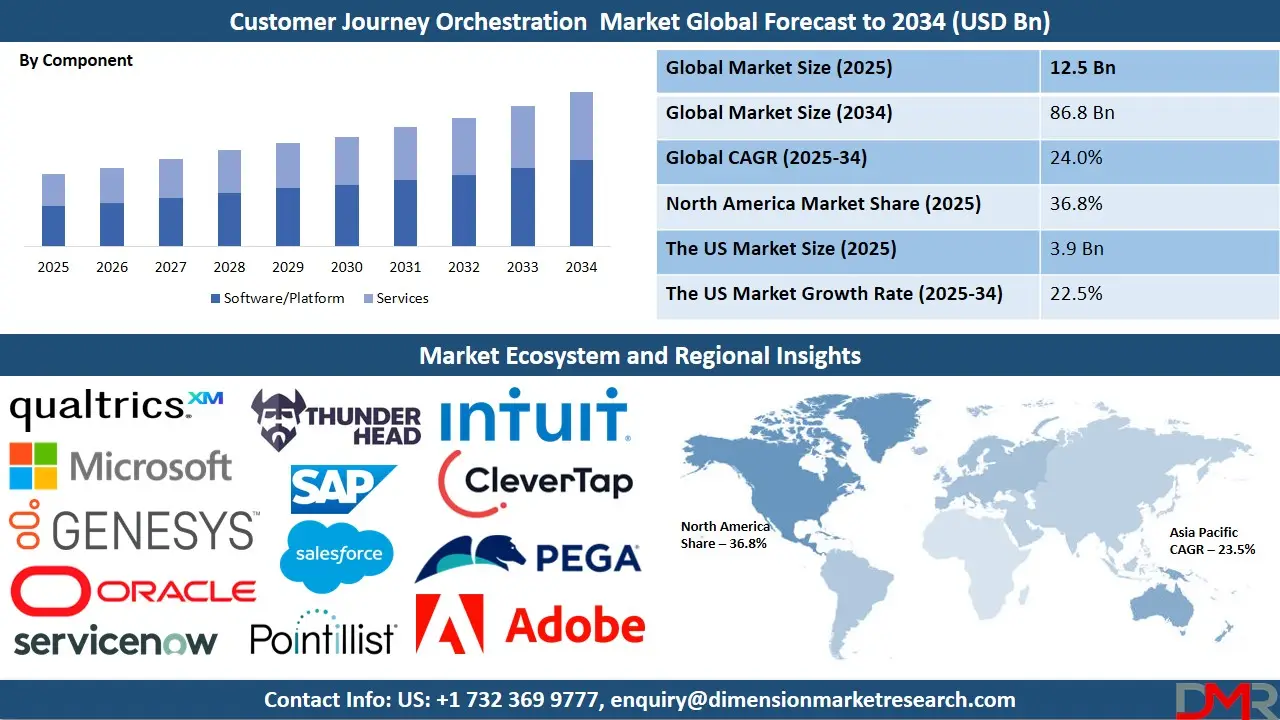
The Global Customer Journey Orchestration Market is experiencing a rapid growth with companies focusing more and more on real-time, data-led engagement strategies to improve customer experience. Customer journey orchestration enables companies to track and analyze interactions across channels and automate them to deliver seamless, hyper-personalized engagement. With AI-based automation, omnichannel marketing, and predictive analytics, companies are investing in advanced orchestration software to improve customer satisfaction, retention, and conversion.
ℹ
To learn more about this report –
Download Your Free Sample Report Here
The market is driven by the adoption of AI, machine learning (ML),
natural language processing (NLP), and behavior analytics to process high volumes of customer interaction data and deliver contextual, personalized interactions. AI systems apply real-time decisioning, predictive modeling, and workflow automation to allow companies to create responsive customer journeys informed by user behavior, preference, and prior interactions. Cloud-based deployments are in the lead, with scalability, flexibility, and simple integration with existing CRM, automation, and customer experience (CX) systems.
Retail and e-commerce, BFSI, healthcare, telecoms, and travel and hospitality are a few of the most significant industries leveraging customer journey orchestration to enhance engagement, sales, and service excellence. Organizations are increasingly leveraging website and app analytics, customer data platforms (CDPs), and real-time behavioral data to provide dynamic, personalized interactions in digital and physical environments. Cross-channel automation, campaign optimization, and triggering proactive customer service are a few features that are driving adoption.
The market is dominated by North America with a well-established CX ecosystem, high AI adoption rates, and the presence of major solution providers like Salesforce, Adobe, Pegasystems, and NICE Ltd. Additionally, the region leads in implementing Segment Journey Orchestration and real-time customer journey orchestration, enhancing personalized customer experiences. Nevertheless, in Asia-Pacific, the highest CAGR is expected to be fuelled by increased digital transformation, high levels of internet penetration, and increased demand for AI-based customer engagement solutions, including real-time customer journey orchestration, in developing economies.
ℹ
To learn more about this report –
Download Your Free Sample Report Here
Strategic partnerships, mergers and acquisitions, and AI-led innovations are revolutionizing competition. Organizations are investing in real-time journey analytics, automation software, and conversational AI to enhance orchestration capabilities. With companies increasingly shifting towards customer-centric engagement models, the Customer Journey Orchestration Market is set to expand drastically with a surge in demand for AI-based, scalable solutions to optimize customer experience and business outcomes.
The US Customer Journey Orchestration Market
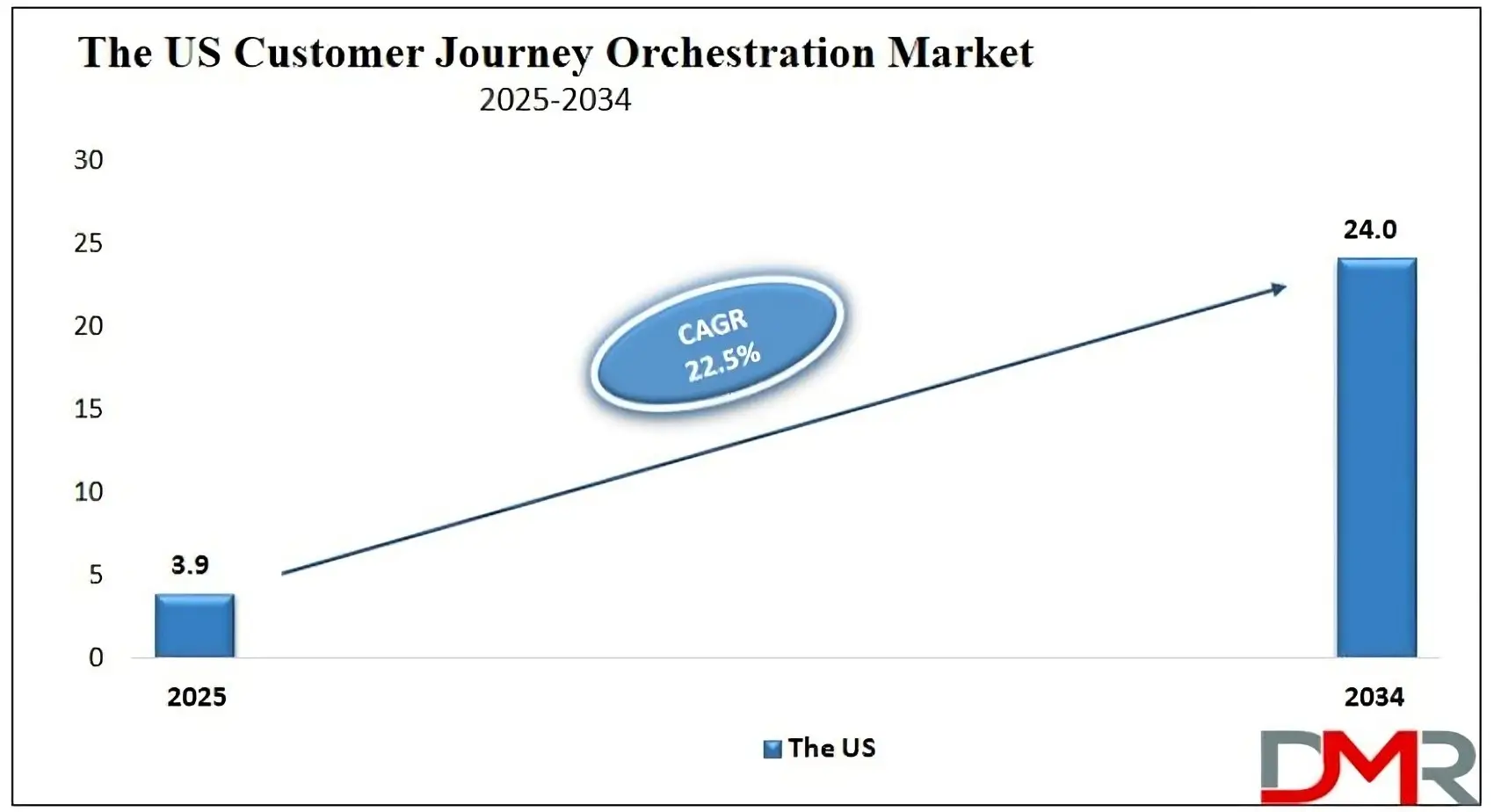
The US Customer Journey Orchestration Market is projected to reach USD 3.9 billion by the end of 2025 and grow substantially to an expected USD 24.0 billion market by 2034 at an anticipated CAGR of 22.5%.
ℹ
To learn more about this report –
Download Your Free Sample Report Here
The U.S. Customer Journey Orchestration Market is a pioneer in innovation and adoption with a highly developed technological ecosystem, high digital literacy, and data-driven business models. America's large and diverse population and highly developed e-commerce ecosystem provide businesses with access to massive customer data, which can be leveraged to provide highly personalized and automated engagement strategies. Having digitally savvy consumers hastens the demand for seamless AI-powered customer experience, and this in turn fuels continuous innovation in journey orchestration solutions.
The US market is backed by leading-edge tech vendors such as Salesforce, Adobe, Pegasystems, and NICE Ltd., who are making investments in AI, ML, predictive analytics, and omnichannel automation. Retail, healthcare, BFSI, and telecom are significant industries employing such solutions to improve customer retention, engagement, and revenue growth. AI-powered orchestration platforms allow businesses to monitor actual customer behavior in real-time, optimize campaigns, and automate decision-making, hence constructing dynamic and responsive customer journeys.
But there are still challenges like stringent data privacy regulations (GDPR, CCPA) and complexity in orchestrating across multiple platforms and legacy systems. All this aside, however, the U.S. market is still poised for steady growth, driven by ongoing digital transformation initiatives and customer experience (CX) as a differentiator.
Global Customer Journey Orchestration Market: Key Takeaways
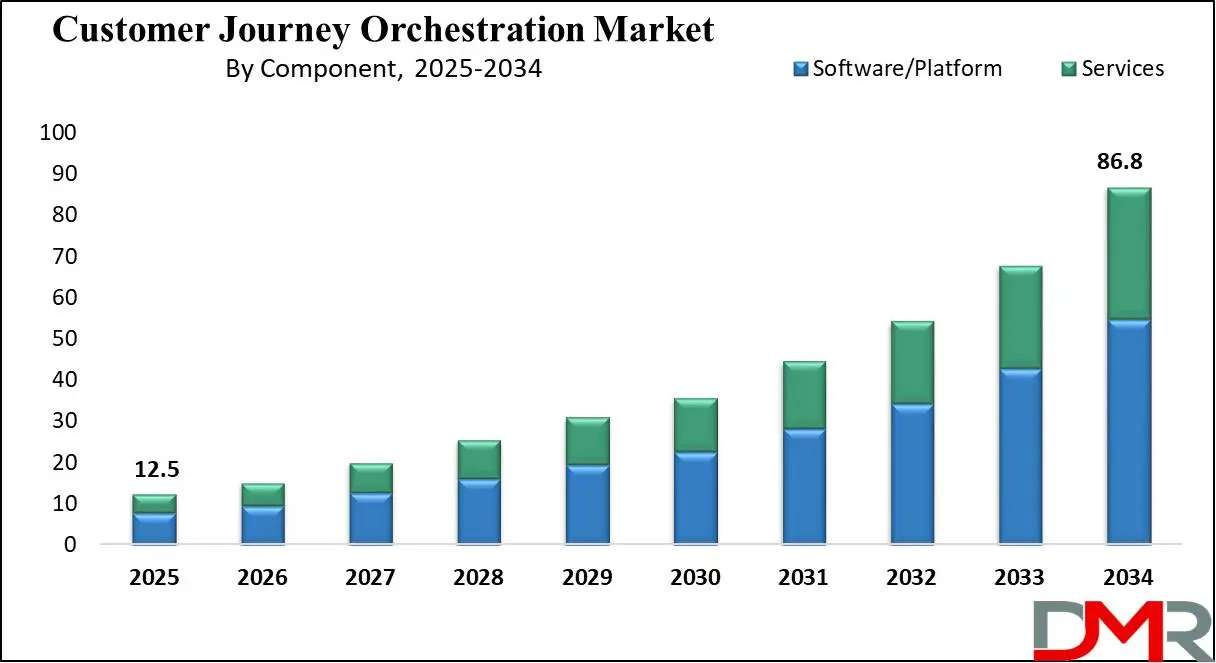
- Global Market Size Analysis: The Global Customer Journey Orchestration Market is estimated to reach USD 12.5 billion in 2025 and is projected to grow to USD 86.8 billion by the end of 2034.
- The US Market Size Analysis: The US Customer Journey Orchestration Market is projected to be valued at USD 3.9 billion in 2025 and is expected to reach USD 24.0 billion by 2034, expanding at a CAGR of 22.5% over the forecast period.
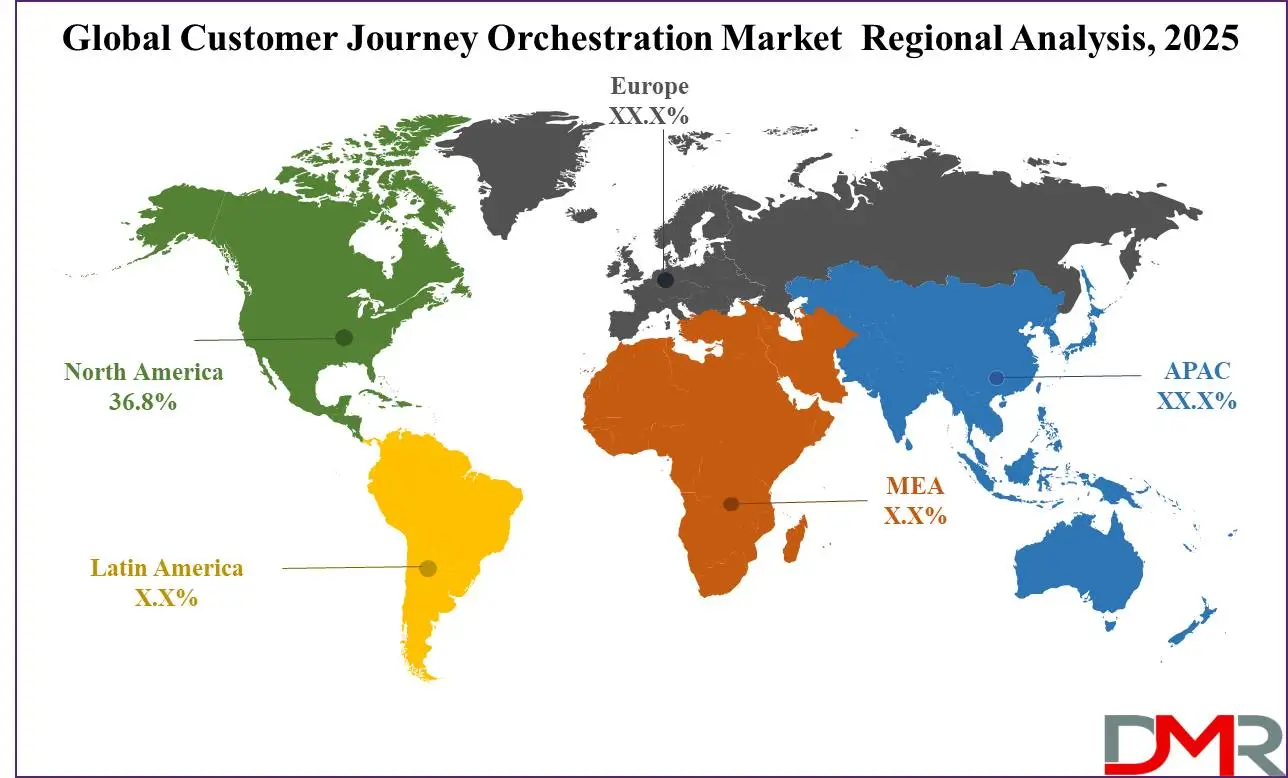
- Regional Analysis: North America is expected to dominate the Global Customer Journey Orchestration Market, accounting for approximately 36.8% of the total market share in 2025.
- Key Players: Some of the major players in the Global Customer Journey Orchestration Market include Salesforce, Adobe, Microsoft, Oracle, Pegasystems, NICE, Genesys, Braze, Airship, Insider, Iterable, and other key players.
- Global Market Growth Rate: The Global Customer Journey Orchestration Market is projected to expand at a CAGR of 24.0% over the 2025–2034 forecast period, supported by increasing adoption of AI-powered customer engagement, cloud-based orchestration platforms, and omnichannel personalization solutions.
Global Customer Journey Orchestration Market: Use Cases
- Retail Personalization: With customer journey orchestration, retailers use browsing and purchasing history to deliver personalised product recommendations and targeted promotions across multiple channels, enhancing customer experience, customer loyalty, and overall sales conversion rates.
- Healthcare Engagement: Health professionals use journey orchestration to simplify interactions with patients, from auto-scheduling appointment reminders to post-procedure follow-ups, to provide personalized care, improve patient satisfaction, and improve health outcomes through real-time engagement across digital and offline channels.
- Banking Onboarding: Customer journey orchestration is used in banks to simplify and automate account opening procedures to deliver a seamless, compliant onboarding process through minimized paper-based processes, real-time instructions, and enhanced user engagement through digital and AI-based workflows.
- Travel and Hospitality: Travel operators coordinate personalized travel arrangements, employing real-time customer information to deliver personalized travel experience, dynamic pricing, and real-time information, improving overall customer satisfaction, loyalty, and operating effectiveness in booking, cancellation, and customer service.
- Telecom Customer Retention: Customer journey orchestration software is used by telecomm operators to identify at-risk subscribers, evaluate churn signals, and deliver customized retention offers, loyalty programs, and pro-active customer care, thus reducing churn rate and enhancing customer engagement in the long run.
Global Customer Journey Orchestration Market: Stats & Facts
- According to Salesforce (2022), 88.0% of customers consider the experience a company provides as important as its products or services, highlighting the significance of consistent engagement and seamless customer journeys.
- According to Zendesk (2024), 63.0% of consumers are willing to switch to a competitor after a single negative experience, emphasizing the importance of delivering consistent service quality and personalized interactions.
- According to Twilio (2024), 64.0% of consumers would stop using a brand if their experiences were not personalized, demonstrating the growing importance of individualized engagement and customer journey optimization.
- According to Braze (2026), 93.0% of marketing leaders believe AI helps them understand customer needs, while only 53.0% of consumers feel brands accurately predict their preferences, indicating a significant gap between business perceptions and customer experiences.
- According to Twilio (2025), 71.0% of consumers abandon purchases when customer experiences fail to meet their expectations, highlighting the importance of relevant communication and real-time engagement throughout the purchasing journey.
- According to Braze (2026), 60.0% of surveyed marketing leaders use AI to support personalization across channels, while nearly half lack the necessary tools to coordinate experiences across those channels, emphasizing the need for integrated journey orchestration platforms.
- According to Twilio (2024), only 16.0% of brands strongly agree that they possess sufficient customer data to understand consumer needs, highlighting challenges in customer data integration, analytics, and personalized engagement.
- According to Zendesk (2024), 67.0% of consumers are willing to delegate activities such as order tracking and personalized product recommendations to AI assistants, reflecting growing acceptance of automated customer interactions.
- According to Twilio (2025), 88.0% of consumers are more likely to purchase when brands personalize engagement in real time, while only 44.0% of brands report delivering such personalization, indicating opportunities for advanced orchestration technologies.
- According to Braze (2026), consumers whose needs are accurately predicted and met by brands are 30.0% more likely to remain loyal and 26.0% more likely to recommend those brands, demonstrating the importance of relevant, data-driven customer experiences.
Global Customer Journey Orchestration Market: Market Dynamic
Driving Factors in the Global Customer Journey Orchestration Market
Adoption of AI and Machine Learning for Advanced Customer Insights
Businesses are increasingly integrating
artificial intelligence (AI) and machine learning (ML) into customer journey orchestration platforms to enhance data analytics, predictive modeling, and customer behavior forecasting. AI-driven solutions enable companies to analyze real-time customer interactions across multiple touchpoints, providing personalized recommendations and engagement strategies. These technologies facilitate real-time decision-making, allowing businesses to respond proactively to customer needs.
Furthermore, AI-powered automation reduces manual intervention, enhancing efficiency in customer engagement workflows. As AI and ML capabilities continue to evolve, businesses gain a competitive edge by delivering hyper-personalized experiences, improving customer retention, and driving revenue growth. The integration of AI and ML in customer journey orchestration is becoming a standard practice across industries, from retail to financial services, leading to increased investments in intelligent orchestration solutions.
Growing Demand for Omnichannel Customer Experience Management
Customers now interact with brands across multiple digital and offline channels, including websites, mobile apps, social media, emails, and physical stores. Organizations are prioritizing omnichannel journey orchestration to ensure seamless, consistent, and personalized customer experiences. By leveraging customer data from different sources, businesses can create a unified view of customer interactions, enabling contextually relevant and personalized engagements across all touchpoints.
Advanced orchestration platforms integrate data from CRM systems, marketing automation tools, and analytics engines to facilitate real-time and predictive customer journey mapping. This trend is particularly prominent in industries such as e-commerce, healthcare, and banking, where customer expectations for seamless experiences are high. Companies are investing in omnichannel orchestration tools to improve engagement, boost customer satisfaction, and gain a competitive advantage in the digital marketplace.
Restraints in the Global Customer Journey Orchestration Market
Data Privacy and Compliance Challenges
The increasing reliance on customer data for personalized journey orchestration presents significant privacy and regulatory challenges. Organizations must navigate complex data protection laws such as the General Data Protection Regulation (GDPR) in Europe and the California Consumer Privacy Act (CCPA) in the U.S. Compliance with these regulations requires businesses to implement stringent data governance practices, ensuring transparency, consent management, and secure data storage.
Non-compliance can lead to legal penalties, reputational damage, and loss of customer trust. Additionally, concerns over data breaches and unauthorized access deter some businesses from fully leveraging customer journey orchestration platforms. Organizations must invest in robust cybersecurity measures and compliance frameworks to address these challenges and maintain consumer confidence.
Integration Complexity and High Implementation Costs
Implementing a customer journey orchestration platform requires seamless integration with existing marketing, sales, and customer service systems. Many organizations face challenges in aligning these platforms with legacy systems, leading to technical complexities and higher costs. The need for skilled professionals to manage orchestration workflows and analyze customer data adds to the operational burden.
Small and medium-sized enterprises (SMEs) often struggle with the high cost of implementation and maintenance, limiting adoption. Additionally, businesses with decentralized customer engagement processes may find it difficult to unify data from multiple touchpoints. Overcoming these challenges requires vendors to offer user-friendly, scalable, and cost-effective orchestration solutions with simplified integration capabilities.
Opportunities in the Global Customer Journey Orchestration Market
Expansion of Customer Journey Orchestration in Emerging Markets
Developing regions, particularly in Asia-Pacific, Latin America, and the Middle East, present significant growth opportunities for customer journey orchestration providers. Businesses in these regions are increasingly investing in digital transformation to enhance customer engagement and improve competitive positioning. Rapid smartphone penetration, growing internet usage, and expanding e-commerce ecosystems are driving demand for personalized and seamless customer experiences.
Additionally, rising consumer expectations in emerging markets encourage enterprises to implement advanced orchestration strategies. Local businesses and global companies expanding into these markets seek AI-powered and cloud-based solutions to enhance their omnichannel engagement efforts. As digital adoption grows in emerging economies, customer journey orchestration vendors have a lucrative opportunity to penetrate these high-potential markets with tailored solutions.
Integration of Customer Journey Orchestration with AI-Powered Chatbots and Virtual Assistants
AI-powered
chatbots and virtual assistants are transforming customer interactions by offering real-time support, personalized recommendations, and automated responses. Integrating customer journey orchestration with
conversational AI enhances customer engagement by providing seamless interactions across multiple channels. Businesses can use AI-driven orchestration to analyze chatbot interactions, optimize response strategies, and improve overall customer satisfaction.
This integration is particularly valuable in industries like e-commerce, healthcare, and banking, where automated assistance plays a crucial role in customer service. As conversational AI continues to evolve, companies are expected to leverage customer journey orchestration to create more intelligent, context-aware chatbot experiences. This trend presents a major opportunity for market expansion as organizations seek to enhance their digital engagement capabilities.
Trends in the Global Customer Journey Orchestration Market
Rising Demand for Personalization in Customer Engagement
Personalization has become a key driver of customer satisfaction and brand loyalty, prompting organizations to invest in customer journey orchestration solutions. Customers expect tailored experiences that cater to their preferences, behaviors, and past interactions with a brand. Advanced orchestration tools use real-time data analytics to identify patterns, predict customer needs, and deliver personalized content, offers, and recommendations.
Industries such as retail, financial services, and hospitality leverage personalization to enhance customer retention and drive sales. By implementing AI-powered customer journey orchestration, businesses can create dynamic, customized engagement strategies that foster deeper relationships and improve conversion rates. The growing emphasis on personalization is fueling market growth as companies seek to optimize customer interactions at every stage of the journey.
Increasing Adoption of Cloud-Based Customer Journey Orchestration Solutions
The shift toward cloud-based technologies is significantly driving the adoption of customer journey orchestration platforms. Cloud-based solutions offer scalability, flexibility, and cost-effectiveness, enabling businesses to manage complex customer journeys efficiently. Organizations benefit from real-time data processing, seamless integration with existing systems, and enhanced accessibility, allowing teams to collaborate on customer engagement strategies.
Cloud-based platforms also support AI-driven automation, real-time analytics, and cross-channel orchestration, improving customer experience management. As more businesses embrace digital transformation, the demand for cloud-based customer journey orchestration tools continues to rise. The accessibility of software-as-a-service (SaaS) solutions further accelerates adoption, particularly among small and medium-sized enterprises (SMEs) looking for affordable and scalable customer engagement solutions.
Global Customer Journey Orchestration Market: Research Scope and Analysis
By Component Analysis
The Software/Platform is projected to dominate this segment in the Customer Journey Orchestration Market as it
holds 63.1% of market share in 2025 through customer interaction centralization across multiple touchpoints. Such software and platforms leverage AI and
machine learning to provide real-time data, predictive analytics, and automation for decision-making, enabling businesses to optimize customer journeys effectively. Such solutions are increasingly being used in organizations to enhance customer engagement, retention, and revenue growth.
Besides, cloud-based systems have further fueled adoption since businesses seek cost-efficient and scalable orchestration. Customer journey orchestration systems are distinct from customer engagement tools since they integrate seamlessly with CRM, customer service systems, and marketing automation to provide a single customer interaction overview.
Increasing customer demand for hyper-personalization in customer experience programs has likewise fueled adoption. Advanced AI-based orchestration technologies assess behavior patterns, historical purchases, and real-time engagement to deliver personalized experience across digital and physical channels.
Leading companies such as Salesforce, Adobe, and Pegasystems continue to innovate in this space with a focus on enhancing automation, AI-driven insights, and omnichannel orchestration capabilities. With businesses concentrating on data-led customer experience (CX) strategies, software/platform-based solutions remain the most popular choice for smooth customer journey management and measurable business outcomes.
By Deployment Analysis
Cloud-based deployment is expected to dominate the global Customer Journey Orchestration Market in 2025, supported by increasing enterprise adoption of scalable, flexible, and AI-powered customer engagement platforms. Cloud-based solutions enable organizations to integrate customer data from multiple touchpoints, automate personalized interactions, and manage customer journeys in real time. Their compatibility with CRM platforms, customer data platforms, marketing automation systems, and analytics tools supports seamless omnichannel orchestration. The growing adoption of software-as-a-service solutions further strengthens cloud deployment, particularly among enterprises seeking lower infrastructure maintenance requirements and faster implementation.
Large enterprises are increasingly adopting cloud-based orchestration platforms to coordinate customer experiences across websites, mobile applications, social media, email, and customer support channels. Meanwhile, small and medium-sized enterprises benefit from subscription-based pricing, simplified integration, and access to advanced AI and machine learning capabilities. Although on-premises deployment remains relevant for organizations with strict data governance, security, and infrastructure requirements, cloud-based deployment is expected to maintain its leading position throughout the forecast period.
By Application Analysis
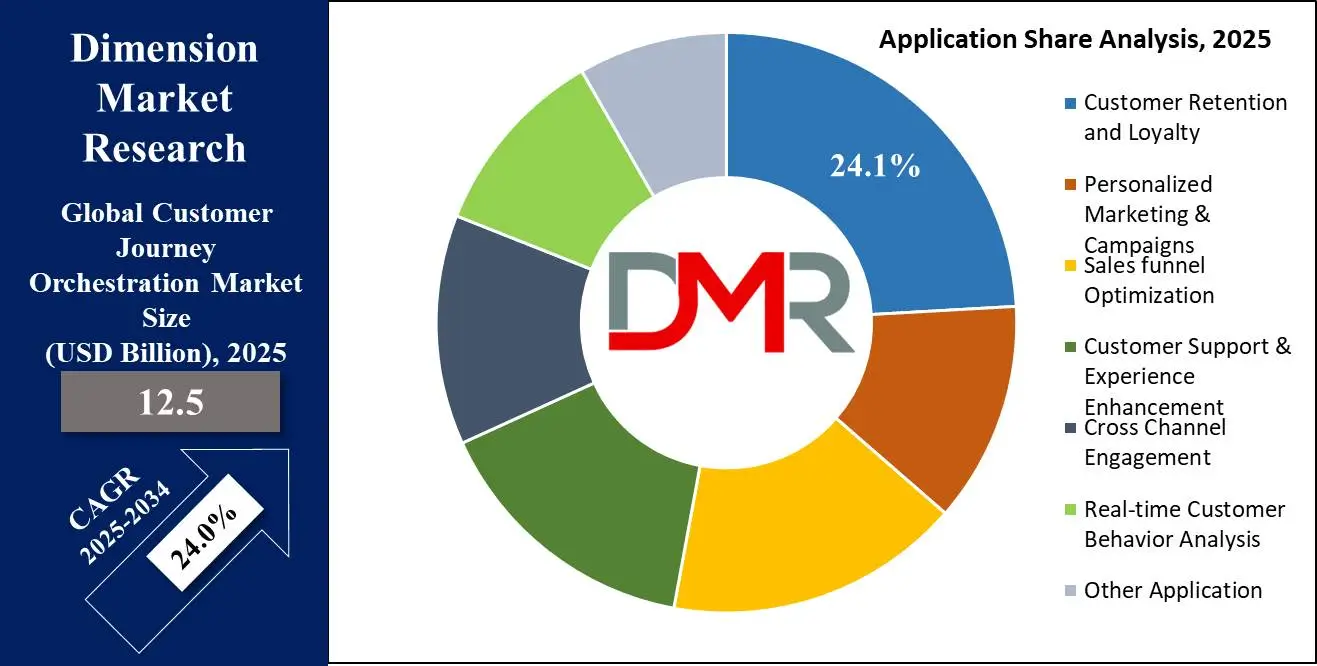
The Customer Journey Orchestration Market is anticipated to dominate by the Personalized Marketing & Campaigns in this segment with the highest market share in 2025 due to greater demands from brands to deliver highly contextual and targeted interactions. One-size-fits-all generic marketing is being substituted with hyper-personalized campaigns that speak to customers in terms of real-time behavior, preferences, and historical interactions.
ℹ
To learn more about this report –
Download Your Free Sample Report Here
Customer journey orchestration platforms leverage AI, predictive analytics, and automation to enable businesses to create dynamic, multi-channel campaigns tailored to specific customers. Customer journey orchestration platforms leverage real-time user behavior on websites, apps, email, social media, and offline channels to trigger personalized interactions in the appropriate channel and moment.
Enterprises across industries like retail, e-commerce, BFSI, and telecomm use such solutions to maximize customer acquisition, retention, and lifetime value (LTV). AI-driven orchestration-based personalized campaigns have been proven to increase conversion rates and ROI and enhance customer experience overall.
Adobe, Salesforce, and Oracle continuously enhance their AI-powered customer journey orchestration capabilities to optimize personalized marketing strategies more effectively. With customer demands for personalized experience still on the rise, the Personalized Marketing & Campaigns segment is still the most prominent use, helping companies maximize engagement, brand loyalty, and revenue growth.
By Data Source Analysis
The Customer Journey Orchestration Market is poised to be led by the Website & Mobile App Analytics in this segment since increasingly companies are employing digital touchpoints to engage with and convert customers. With digital banking, e-commerce, and mobile-first interactions taking hold, customer behavior is increasingly being understood through analyzing interactions with websites and apps.
Customer journey orchestration platforms use real-time analytics from websites and apps to map customer interactions, find pain points, and maximize engagement strategies. Customer journey orchestration platforms track clickstream behavior, session time, page views, abandoned cart rates, in-app behavior, and navigation patterns in apps to provide actionable information to improve CX.
The application of AI and machine learning allows businesses to predict customer intent, personalize recommendations, and initiate real-time interactions. Financial services, travel businesses, retailers, and news websites apply website and mobile analytics to enhance user experience, reduce churn, and increase conversions.
Market leaders such as Google (Google Analytics), Adobe, and Microsoft continue to innovate in digital analytics with AI-based behavior tracking, predictive analytics, and cross-device tracking capabilities. With customer interactions being more and more online, Website & Mobile App Analytics dominance as a source of data is still a priority for businesses looking to drive customer-centric digital transformation.
By Technology Integration Analysis
This segment is projected to dominate by
Artificial Intelligence (AI) and Machine Learning (ML) as it holds the highest market share in 2025. The collaboration between Artificial Intelligence (AI) and Machine Learning (ML) is revolutionizing the Customer Journey Orchestration Market to deliver real-time, data-driven, and hyper-relevant engagement across numerous touchpoints. With them, businesses can process large volumes of customer interaction data, recognize patterns in behavior, and automate decisions, enhancing customer experience immensely.
AI-powered orchestration platforms apply predictive analytics, sentiment analysis, and NLP to develop contextual customer interactions. Business solutions allow companies to predict customer demands, optimize campaigns, and proactively start engagement strategies in reaction to real-time behavior. Customer journey models are updated and enhanced in real-time with machine learning algorithms, which allow companies to develop highly dynamic and personalized customer journeys.
The adoption of AI and ML in customer journey orchestration is gathering momentum in retail, finance, telecom, and healthcare industries, where businesses are looking to improve customer retention, conversion rates, and lifetime value (LTV). AI-powered chatbots, auto-recommendations, and responsive advertising are being leveraged to deliver personalized engagement on web, mobile, email, and social media.
Key solution providers such as Salesforce, Adobe, Pegasystems, NICE Ltd., and Oracle are investing heavily in AI-based journey orchestration to enhance automation, predictive analytics, and customer engagement strategies. Real-time, omnichannel orchestration is still in high demand, and AI & ML is hence the dominant tech integration in this arena. With businesses concentrating on data-driven CX optimization, AI-based orchestration will be at the core of customized customer interactions, providing seamless, scalable, and intelligent engagement on all digital and offline channels.
By Organization Size Analysis
Large Enterprises is expected to command this segment in the customer journey orchestration market, with the highest market share in 2025. Large Enterprises have a majority share in Customer Journey Orchestration due to complexity in managing multi-channel customer interactions, large volumes of data, and international customer bases. Large companies require advanced AI-based orchestration systems to deliver seamless and personalized engagement across a variety of touchpoints, e.g., web, mobile, social media, call centers, and in-store.
These companies emphasize real-time decision-making, predictive analytics, and omnichannel automation to deliver maximum customer satisfaction and revenue growth. They can also invest in AI-powered CX solutions to incorporate journey orchestration platforms with their existing CRM, marketing automation, and analytics systems.
Banking, telecom, healthcare, and retail sectors have their business relying on such platforms to optimize customer interactions, improve retention levels, and ease their process of marketing. Large enterprises have to contend with complex regulations as well, and thus on-premises and private cloud installations are a preferred solution to ensure data security and compliance.
Large companies are being approached by vendors like Microsoft, NICE Ltd., and Oracle with AI-based, scalable orchestration solutions that provide rich customer insights, workflow automation, and personalisation. Large companies will remain the prime movers in Customer Journey Orchestration adoption, driving market growth with digital transformation strategies.
By Industry Vertical Analysis
The Customer Journey Orchestration market is anticipated to be dominated by the Retail & E-commerce sector in this segment due to the emphasis on hyper-personalisation, omnichannel engagement, and AI-powered customer interactions. With digital purchases, mobile commerce, and digital-first interactions increasingly in use, retailers have to deliver context-based and real-time engagement to enable conversions and customer loyalty.
Customer journey orchestration systems allow retailers to track and analyze in-app engagement, social media engagement, purchasing behavior, and website traffic to deliver customized promotions, dynamic pricing, and predictive recommendations. AI-powered orchestration systems optimize customer retention programs, abandoned cart recovery, and campaigns to deliver a seamless customer experience.
Apart from this, retailers are investing in conversational AI,
chatbots, and voice commerce to enhance customer engagement on digital touchpoints. Amazon, Walmart, and Alibaba are employing AI-fueled journey orchestration to deliver real-time customized promotions, auto customer service, and pro-active engagement.
Leading solution providers such as Adobe, Salesforce, and SAP are continuously enhancing their AI-powered CX platforms to meet mounting retail and e-commerce business needs. With more competition in digital commerce, retailers will increasingly apply Customer Journey Orchestration solutions to optimize customer satisfaction, enhance conversion rates, and establish brand loyalty in the long term.
The Global Customer Journey Orchestration Market Report is segmented on the basis of the following
By Component
- Software/Platform
- AI-driven CJO Platforms
- Workflow Automation Tools
- Real-time Customer Interaction Software
- Customer Data Platforms (CDP) & Data Management
- Journey Analytics & Optimization Tools
- Services
- Professional Services
- Consulting
- Support and Maintenance
- Deployment and Integration
- Managed Services
By Deployment
By Application
- Customer Retention and Loyalty
- Personalized Marketing & Campaigns
- Sales funnel Optimization
- Customer Support & Experience Enhancement
- Cross Channel Engagement
- Real-time Customer Behavior Analysis
- Other Application
By Data Source
- Customer Relationship Management (CRM) Data
- Website & Mobile App Analytics
- Social Media & Digital Engagement Data
- Call Center & Customer Support Data
- Survey & Feedback Data
- IoT & Sensor Data
- Other Data Source
By Technology Integration
- Artificial Intelligence (AI) & Machine Learning (ML)
- Big Data & Analytics
- Customer Data Platforms (CDP)
- Automation & Workflow Orchestration
- Natural Language Processing (NLP)
- Predictive Analytics
- Other Technology Integration
By Organization Size
- Large Enterprises
- Small & Medium Enterprises (SMEs)
By Industry Vertical
- Retail & E-commerce
- Banking, Financial Services, and Insurance (BFSI)
- Healthcare & Life Sciences
- IT & Telecommunications
- Media & Entertainment
- Travel & Hospitality
- Automotive
- Government & Public Sector
- Others
Global Customer Journey Orchestration Market: Regional Analysis
Region with the Highest Market Share
North America is projected to dominate the market for the global customer journey orchestration market as it is poised to
hold 36.8% of the market share in 2025. North America is a leadership market for Customer Journey Orchestration with a high adoption rate for AI-powered customer experience (CX) solutions, a strong presence of tech giants, and a wide adoption of omnichannel engagement platforms.
It is dominated by big vendors like Salesforce, Adobe, and Microsoft, who continuously enhance their platforms with real-time customer data integration and predictive analytics. America is a digital transformation frontrunner, with retail, BFSI, healthcare, and telecoms leveraging auto customer journey orchestration (CJO) solutions to improve customer experience and retention.
ℹ
To learn more about this report –
Download Your Free Sample Report Here
In addition, North American companies prioritize data-driven decision-making, with high investments in CDPs, AI-based chatbots, and automation software that optimize customer interactions. Customer data security-friendly regulations and digital engagement in the region contribute to enterprise adoption levels for AI-powered journey mapping software. Mature cloud infrastructures and stable API ecosystems in place further contribute to North America's leadership, enabling end-to-end integration of customer journey analytics, automation, and engagement capabilities across multiple touchpoints.
Region with the Highest CAGR
Asia-Pacific is expected to register the fastest growth in the global Customer Journey Orchestration Market during the forecast period, supported by rapid digital transformation, expanding e-commerce activities, and increasing enterprise adoption of AI-powered customer engagement technologies. Countries such as China, India, Japan, South Korea, and Australia are experiencing growing demand for personalized customer experiences across retail, banking, telecommunications, healthcare, and digital services. Rising smartphone penetration, increasing internet connectivity, and the expansion of digital payment ecosystems are generating substantial customer interaction data, encouraging organizations to adopt advanced journey analytics and orchestration platforms.
China and India present considerable growth opportunities due to their large digital consumer bases, expanding online retail sectors, and investments in cloud-based customer experience technologies. Japan and South Korea are advancing customer engagement through AI-powered automation, predictive analytics, and integrated digital platforms. Increasing adoption of cloud solutions among small and medium-sized enterprises, alongside growing demand for omnichannel communication, is expected to strengthen regional market expansion. As businesses prioritize customer retention, personalized marketing, and improved service efficiency, Asia-Pacific is anticipated to remain a key growth region for customer journey orchestration solutions through 2034.
By Region
North America
Europe
- Germany
- The U.K.
- France
- Italy
- Russia
- Spain
- Benelux
- Nordic
- Rest of Europe
Asia-Pacific
- China
- Japan
- South Korea
- India
- ANZ
- ASEAN
- Rest of Asia-Pacific
Latin America
- Brazil
- Mexico
- Argentina
- Colombia
- Rest of Latin America
Middle East & Africa
- Saudi Arabia
- UAE
- South Africa
- Israel
- Egypt
- Rest of MEA
Global Customer Journey Orchestration Market: Competitive Landscape
The global Customer Journey Orchestration Market is characterized by competition among enterprise software providers, customer experience management companies, marketing automation platforms, and specialized journey orchestration vendors. Major participants, including Salesforce, Adobe, Microsoft, Oracle, SAP, Pegasystems, NICE, and Genesys, offer AI-powered customer engagement, real-time analytics, decisioning, and omnichannel automation capabilities. Specialized providers such as Braze, Airship, Insider, Iterable, Optimove, and CleverTap further strengthen competition through personalized marketing, customer lifecycle management, and cross-channel engagement solutions.
Industry consolidation has also influenced the competitive landscape, with established technology providers integrating acquired journey orchestration capabilities into broader customer experience platforms. Key competitive factors include AI-driven personalization, cloud scalability, integration flexibility, real-time customer data processing, automation capabilities, data privacy, and measurable customer engagement outcomes. Continuous product innovation, strategic partnerships, and enterprise adoption of integrated customer experience platforms are expected to shape market competition throughout the forecast period.
Some of the prominent players in the Global Customer Journey Orchestration Market are
- Salesforce, Inc.
- Adobe Inc.
- Microsoft Corporation
- Oracle Corporation
- SAP SE
- Pegasystems Inc.
- NICE Ltd.
- Genesys Cloud Services, Inc.
- Qualtrics
- Medallia, Inc.
- CSG International
- Braze, Inc.
- Airship
- Insider
- Iterable, Inc.
- Optimove
- CleverTap
- Zeta Global Holdings Corp.
- ServiceNow, Inc.
- Engage Hub
- Other Key Players
Recent Developments in Global Customer Journey Orchestration Market