Market Overview
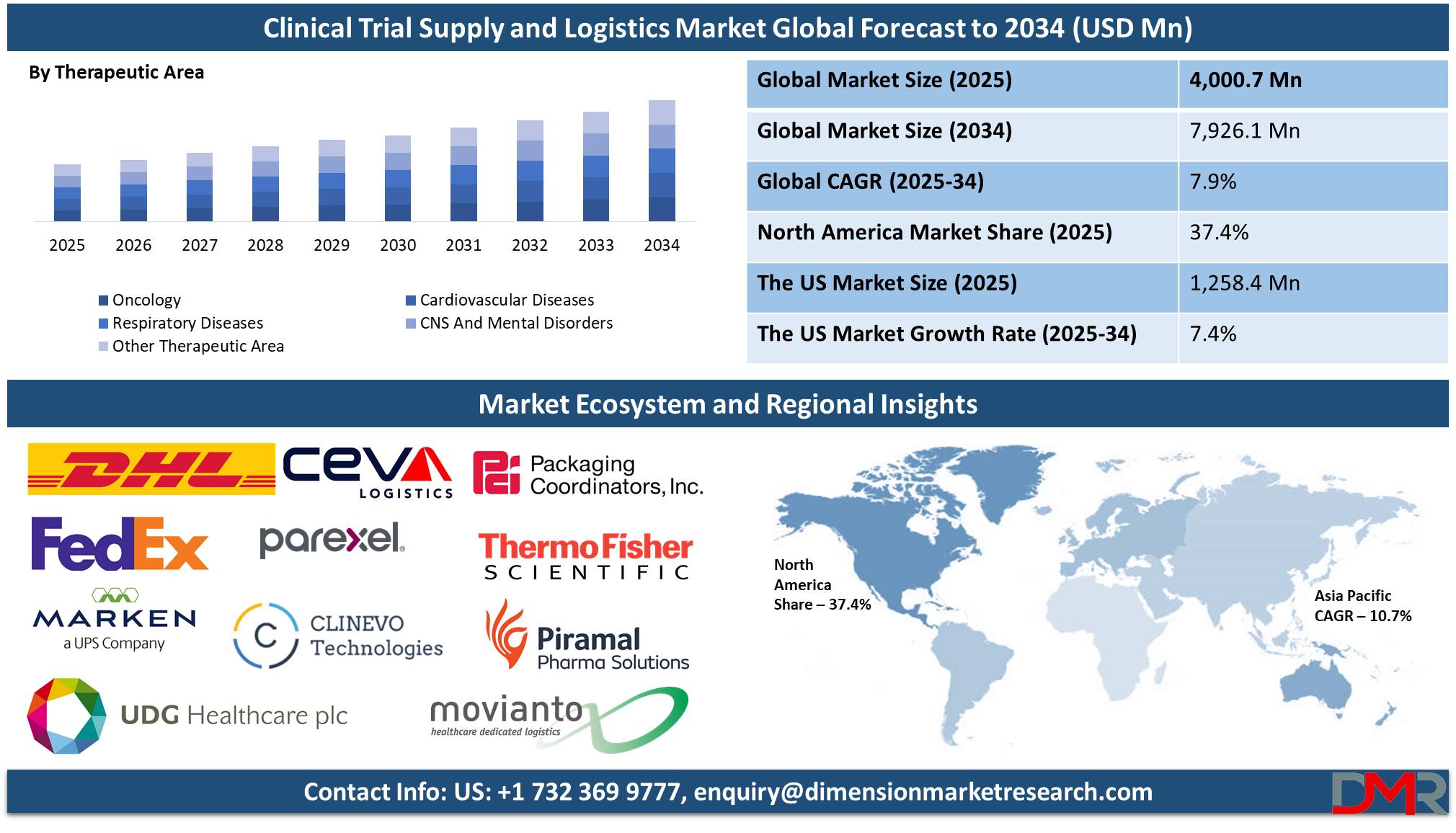
The global Clinical Trial Supply and Logistics Market is projected to be valued at USD 4,000.7 million in 2025 and is expected to reach USD 7,926.1 million by 2034, expanding at a CAGR of 7.9% during the forecast period. Market growth is supported by increasing pharmaceutical and biotechnology research activities, rising demand for temperature-controlled transportation, and the growing complexity of multinational clinical trials. The expanding development of biologics, cell and gene therapies, and personalized medicines is further strengthening demand for specialized clinical supply chain services, including investigational medicinal product packaging, labeling, storage, inventory management, and distribution. Additionally, the increasing adoption of decentralized clinical trials, direct-to-patient delivery models, and digital supply chain technologies is expected to support market expansion through 2034.
ℹ
To learn more about this report –
Download Your Free Sample Report Here
Clinical trial supply and logistics services encompass investigational medicinal product manufacturing coordination, comparator sourcing, packaging, labeling, storage, inventory management, transportation, and distribution to clinical trial sites. These activities require careful planning to maintain product integrity, ensure regulatory compliance, and prevent supply interruptions. The growing development of biologics, vaccines, cell and gene therapies, and personalized medicines is increasing demand for controlled-temperature transportation, specialized packaging, and real-time shipment monitoring.
The adoption of decentralized and hybrid clinical trial models is further influencing logistics requirements, as sponsors increasingly incorporate direct-to-patient delivery and remote study participation. Digital technologies, including artificial intelligence, predictive analytics, and Internet of Things-enabled monitoring systems, are improving inventory forecasting, shipment visibility, and temperature control. Meanwhile, pharmaceutical companies are expanding clinical research activities across emerging economies, creating opportunities for specialized distribution networks and regional clinical supply facilities.
Despite these opportunities, the market faces challenges associated with regulatory complexity, high cold chain infrastructure costs, customs procedures, and supply chain disruptions. Clinical supply providers must comply with applicable Good Manufacturing Practice and Good Distribution Practice requirements while maintaining product traceability and operational reliability. Continued investment in temperature-controlled logistics infrastructure, digital supply chain platforms, and strategic partnerships is expected to support market development throughout the forecast period.

ℹ
To learn more about this report –
Download Your Free Sample Report Here
The market will have a rosy future with the growing use of automation, digital value chains, and predictive analysis with AI. Environmentally friendly and sustainable packaging for drugs with no loss in integrity and less environmental impact will become a norm with companies embracing them. Pharmaceutical companies and logistics providers collaborating to develop flexible and adaptable Supply chain networks will drive market growth. With trials becoming ever more complex and global, effective, technology-driven value chain management will remain a success metric.
The US Clinical Trial Supply and Logistics Market
The United States clinical trial supply and logistics market is the largest globally, driven by a strong pharmaceutical sector, leading contract research organizations (CROs), and high R&D investments. The U.S. conducts nearly 40% of all global clinical trials, supported by the FDA’s well-structured regulatory framework. With a rise in trials and an emerging demand for personalized therapy, in the future, the market will expand steadily. With the increased use of biologics, and cell and gene therapies, demand for high-tech supply chain offerings, namely, cold chain logistics, for maintaining drug integrity and compliance, grew manifold.
A significant advantage of the U.S. market is its high diversity in demographics, and effective recruitment of subjects in a range of ethnic groups, with increased integrity and efficacy testing of drugs. The market is also enjoying the fruits of technological innovation, including AI-facilitated logistics, blockchain-facilitated tracking of drugs, and computerized software for managing inventories.
In addition, in-home delivery of drugs and decentralized clinical trials (DCTs) are changing planning in the supply chain, enhancing access for patients, and reducing logistic inefficiencies. With continued investments in precision medicine and increased collaboration between pharmaceutical companies and logistics companies, the U.S. clinical trials supply and logistics market will maintain its stronghold, with efficient and compliant delivery of drugs for future trials.

ℹ
To learn more about this report –
Download Your Free Sample Report Here
A key strength of the US market is its extensive network of clinical research institutions, specialized healthcare facilities, pharmaceutical manufacturers, and logistics service providers. The country's diverse patient populations and established research capabilities support clinical studies across multiple therapeutic areas. Technological advancements, including AI-powered demand forecasting, real-time shipment tracking, automated inventory management, and digital supply chain monitoring, are improving operational efficiency and product traceability. These technologies help clinical trial sponsors and logistics providers optimize inventory levels, minimize shipment delays, maintain product integrity, and meet regulatory requirements.
Furthermore, the increasing adoption of decentralized clinical trials (DCTs) and direct-to-patient drug delivery models is transforming clinical supply chain operations by improving patient accessibility and reducing dependence on traditional clinical trial sites. Growing investments in precision medicine, advanced therapies, and specialized cold chain infrastructure are creating additional opportunities for logistics providers. Strategic collaborations among pharmaceutical companies, biotechnology firms, CROs, and clinical supply organizations are further strengthening distribution capabilities. These developments are expected to support sustained growth in the US Clinical Trial Supply and Logistics Market through 2034.
Global Clinical Trial Supply and Logistics Market: Key Takeaways
- Global Market Size Analysis: The global Clinical Trial Supply and Logistics Market is estimated to reach USD 4,000.7 million in 2025 and is projected to grow to USD 7,926.1 million by 2034, supported by increasing clinical research activities and rising demand for specialized supply chain services.
- The US Market Size Insights: The US Clinical Trial Supply and Logistics Market is projected to be valued at USD 1,258.4 million in 2025 and is expected to reach USD 2,396.5 million by 2034, expanding at a CAGR of approximately 7.4% during the forecast period.
- Regional Insights: North America is expected to dominate the global Clinical Trial Supply and Logistics Market, accounting for approximately 37.4% of total market revenue in 2025, supported by established clinical research infrastructure, strong pharmaceutical R&D investments, and advanced logistics capabilities.
- Key Players Insights: Some of the major players in the global Clinical Trial Supply and Logistics Market include Thermo Fisher Scientific, Catalent (Novo Holdings), Parexel International, Almac Group, Marken (UPS Healthcare), World Courier (Cencora), DHL Group, FedEx, Biocair, Yourway, Sharp Services, PCI Pharma Services, Piramal Pharma Solutions, and other key players.
- Global Market Growth Rate: The global Clinical Trial Supply and Logistics Market is projected to expand at a compound annual growth rate (CAGR) of 7.9% during the 2025–2034 forecast period, driven by increasing demand for temperature-controlled logistics, clinical packaging, investigational product distribution, and decentralized clinical trial services.
Global Clinical Trial Supply and Logistics Market: Use Cases
- Cold Chain Handling: Ensures safe warehousing and shipping of temperature-sensitive drugs, such as biologics and vaccines, and keeps them effective and in compliance with Regulatory requirements at phases of a clinical trial.
- Real-Time Monitoring: Uses IoT technology for tracking temperature and location of shipments during clinical trials, providing real-time information for reduced delays, temperature maintenance, and increased transparency in the supply chain.
- Global Distribution: Empowers efficient distribution of clinical trial materials worldwide, supporting multinational trials through sophisticated logistics and compliance with many and sometimes conflicting requirements in a range of countries.
- Patient-Customized Medicine: Logistics companies manage the distribution of personalized therapies to individual subjects in personalized medicine trials, with timely delivery and compliance with trials in a proper manner.
- Emergency Supply Chain Solutions: In critical trials, quick logistics solutions are utilized to respond to unplanned shortages in supplies, allowing for uninterrupted continuity of clinical trials with no loss in compliance and integrity of the product.
Global Clinical Trial Supply and Logistics Market: Stats & Facts
- According to ClinicalTrials.gov, the public clinical study registry contained more than 600,000 study records by November 2026, covering research locations across all 50 US states and more than 200 countries and territories.
- According to the World Health Organization's International Clinical Trials Registry Platform (ICTRP), the global clinical trial registration database includes records from multiple national and regional registries, supporting international visibility into clinical research activities.
- According to WHO's June 2026 clinical trial registration analysis, registered clinical trial activity generally increased between 1999 and 2025, although annual trends varied across regions and included temporary declines.
- According to WHO's June 2026 analysis, the Western Pacific and South-East Asia regions experienced substantial increases in registered clinical trial activity over the historical reporting period, reflecting the expanding geographic distribution of clinical research.
- According to WHO, retrospective clinical trial registrations remain an important consideration when interpreting historical registration data, as updates to registry records can change previously reported annual totals.
- According to ClinicalTrials.gov, information about study registration, recruitment status, participant enrollment, study outcomes, and results reporting is submitted and updated by study sponsors or investigators.
- According to DHL Group's April 2025 announcement, the company planned an investment of EUR 2 billion by 2030 in healthcare logistics infrastructure, including capabilities relevant to clinical trials, temperature-sensitive pharmaceuticals, and advanced therapies.
- According to Sharp Services' October 2025 announcement, the company planned USD 100 million in investments across its US and European facilities to expand pharmaceutical packaging, sterile manufacturing, clinical supply, and cold chain capabilities.
Global Clinical Trial Supply and Logistics Market Dynamic
Driving Factors in the Global Clinical Trial Supply and Logistics Market
Increasing Number of Clinical Trials Globally
The growing burden of chronic diseases, including cancer, cardiovascular disorders, and neurological conditions, is encouraging pharmaceutical and biotechnology companies to increase investments in clinical research and drug development. Expanding clinical trial activity generates demand for specialized logistics services, including investigational product storage, packaging, labeling, comparator sourcing, and distribution. The increasing geographic reach of multinational clinical studies also requires reliable supply chain coordination across trial sites, regulatory jurisdictions, and transportation networks. Emerging clinical research markets, including India, China, and Brazil, are creating additional opportunities for regional distribution and clinical supply management. Furthermore, the growing development of biologics, vaccines, and advanced therapies is strengthening demand for temperature-controlled transportation and specialized storage infrastructure.
Stringent Regulatory Requirements Driving Compliance-Based Logistics Solutions
The U.S. FDA, European Medicines Agency (EMA), and China’s National Medical Products Administration (NMPA) have placed strong requirements for logistics in clinical trials, including maintenance of cold chains, serialization, and tracking of drugs. GMP and GDP compliance is a necessity, and for that reason, pharmaceutical companies have begun partnering with experienced logistics providers. Regulatory requirements make drugs safer and more efficient but require high investments in infrastructure and technology. Automated compliance software, electronic labels, and real-time shipment tracking software have become increasingly embraced in companies to comply with requirements and have continuous operations in all parts of the world with seamless global operations.
Restraints in the Global Clinical Trial Supply and Logistics Market
High Costs Associated with Cold Chain Logistics
Cold chain logistics is imperative for gene therapies, vaccines, and biologics but at a costly price in terms of temperature controls. There is a strong demand for temperature tracking tools, secure stores, and specialized packaging, and it is costly in terms of operations. There is a risk of degradation through temperature deviation, and with it, loss of financial value. There is significant infrastructure investment in terms of ultra-low temperature freezers and real-time tracking tools for companies in terms of holding drugs in integrity. Cold chain logistics is a challenge for CROs and small pharmaceutical companies with lesser financial capacities.
Supply Chain Disruptions and Geopolitical Risks
Cold chain logistics represents a significant operational challenge in the Clinical Trial Supply and Logistics Market because many investigational medicinal products require controlled storage and transportation conditions. Biologics, vaccines, and certain cell and gene therapies may require refrigerated, frozen, ultra-low-temperature, or cryogenic handling depending on product characteristics. Maintaining these conditions requires specialized packaging, validated shipping containers, temperature-monitoring systems, and qualified storage facilities. Temperature excursions can compromise product integrity, increase wastage, and disrupt clinical trial schedules. The high cost of infrastructure development, equipment maintenance, and regulatory compliance can particularly affect smaller biotechnology companies and contract research organizations with limited operational budgets.
Opportunities in the Global Clinical Trial Supply and Logistics Market
Expansion into Emerging Markets
Pharmaceutical companies have increasingly conducted trials in emerging economies in Asia-Pacific, Latin America, and the Middle East for cost savings and access to a high, treatment-untreated patient population China and India have effective regulatory processes and high recruitment rates, and governments in both countries have been investing in infrastructure and reforming legislation in an attempt to attract more clinical studies. Logistics providers with a strong presence in such regions can benefit from increased demand for clinical trial supply chain management, including import/export compliance, cold storage, and last-mile delivery capabilities.
Rising Demand for Personalized and Precision Medicine
The increasing development of personalized medicines, including cell and gene therapies, is creating opportunities for specialized clinical trial supply and logistics providers. These therapies frequently require complex handling procedures, strict temperature controls, precise shipment scheduling, and coordination between manufacturing facilities and treatment centers. Autologous cell therapies may also require patient-specific chain-of-identity and chain-of-custody management throughout collection, manufacturing, and delivery. Logistics providers offering cryogenic transportation, real-time monitoring, validated packaging, and reliable cross-border distribution are positioned to benefit from these requirements. As precision medicine research expands, demand for flexible and highly controlled clinical supply chain solutions is expected to increase.
Trends in the Global Clinical Trial Supply and Logistics Market
Adoption of Advanced Digital Technologies
Digital transformation is reshaping the Clinical Trial Supply and Logistics Market as companies increasingly adopt artificial intelligence, predictive analytics, Internet of Things technologies, and integrated inventory management systems. AI-powered forecasting tools help organizations estimate investigational product requirements, optimize stock allocation, and reduce the risk of shortages or excess inventory. IoT-enabled monitoring systems provide visibility into shipment location and environmental conditions, supporting the secure transportation of temperature-sensitive clinical materials. Digital supply chain platforms also improve traceability, shipment documentation, and communication among sponsors, contract research organizations, clinical sites, and logistics providers. These capabilities are helping companies improve operational efficiency, maintain product integrity, and strengthen regulatory compliance across increasingly complex clinical trial networks.
Rise of Decentralized and Direct-to-Patient Clinical Trials
Decentralized trials (DCTs) are revolutionizing the supply chain with direct-to-patient (DTP) delivery of drugs. Patient-centric trials, and trials in studies of rare diseases, have fueled demand for flexible distribution frameworks in logistics providers. DCTs reduce patient burden through reduced site visits, with drugs and medical consumables delivered directly to subjects. That momentum accelerated post-pandemic, with companies searching for efficient and effective trials in compliance with Good Distribution Practices (GDP). Home trials have also prompted strong supply chain capabilities that can allow real-time tracking and remote monitoring capabilities.
Research Scope and Analysis
By Service
In this segment Logistics and distribution is projected to dominate as it holds 27.1% of market share in 2025. The distribution and logistics industries have a strong presence in the supply market for clinical trials, with a key role in the timely and secure delivery of investigation drugs, medical devices, and bio-samples. With trials conducted at many locations, and in most cases, in geographically distant countries, effective logistics become a necessity. With temperature-sensitive shipments, compliance with regulating specifications, and real-time tracking, logistics have become a key constituent of clinical trials' supply service.

ℹ
To learn more about this report –
Download Your Free Sample Report Here
Cold chain logistics, in particular, is a strong growth catalyst, with most materials for clinical trials, including biologics, gene and cell therapies, and vaccines, requiring temperature tracking in a restricted environment. There is strong demand for high-tech distribution networks with ultra-cold storage and JIT delivery, and, therefore, high demand for specialist logistics providers. GPS tracking, IoT sensors, and investments in blockchain technology have become a necessity for companies to have transparency and to prevent any sort of disruption in the supply chain.
Adherence to laws and legislation is a contributing role in logistics leadership, with directives under Good Distribution Practice (GDP) governing careful handling protocols for drugs in investigation. Logistics providers must ensure drugs are transported under specific terms and in compliance with region-specific requirements. With the growing use of decentralized clinical trials (DCTs), this industry is even stronger, with direct-to-patient (DTP) distribution channels incurring cutting-edge logistic solutions. As trials go increasingly global and protocols become ever more complex, logistics and distribution form the backbone of clinical trials' supply, allowing for unobstructed delivery of drugs and materials at a range of locations worldwide.
By Phase
Phase III clinical trials are expected to represent a major share of the global Clinical Trial Supply and Logistics Market, supported by their large patient populations, extensive geographic coverage, longer study durations, and significant investigational medicinal product requirements. Compared with early-stage clinical studies, Phase III trials typically involve a greater number of participants and clinical sites, increasing demand for manufacturing coordination, packaging, labeling, storage, inventory management, and global distribution services. The complexity of multinational trial operations further strengthens the need for specialized logistics providers capable of maintaining product integrity and regulatory compliance across different markets.
Phase III trials often require continuous resupply of investigational products, comparator drugs, placebos, and associated clinical materials to multiple study locations. Clinical supply providers must coordinate demand forecasting, temperature-controlled transportation, shipment tracking, and inventory reconciliation to minimize product shortages and wastage. Increasing development of biologics, specialty pharmaceuticals, and personalized therapies adds further complexity to storage and distribution requirements. These factors contribute to substantial spending on clinical trial supply chain services during late-stage drug development.
Phase I and Phase II studies also generate demand for specialized clinical logistics, particularly for investigational therapies requiring careful handling, small-batch manufacturing, and controlled storage conditions. Phase IV studies create additional requirements for post-marketing research and product distribution. However, the larger scale and operational complexity of Phase III studies make them a major contributor to overall clinical trial supply and logistics expenditures.
By Therapeutic Area
Oncology is projected to be the dominant player in the clinical trials supply and logistics field with its high disease burden and constant development of new anti-cancer drugs. Cancer remains one of the most deadly killers in the world, and pharmaceutical companies and institutes have a strong stake in oncology trials. The multi-faceted development of drugs in oncology, such as chemotherapy, immunotherapy, target therapies, and gene therapies, forms a complex infrastructure for a highly specialized supply chain.
Some of the most critical factors in why oncology trials require high logistical support include temperature-sensitive biologics and personalized therapies. There are a variety of therapies for cancer, including monoclonal antibodies and CAR-T cell therapy, that have to be stored and transported at ultra-cold temperatures. Logistics providers have an important role in safeguarding such therapies' effectiveness through complex temperature tracking, cryogenic storing, and channeled distribution.
Also, most trials in oncology have a range of several study locations in a variety of regions, and patient recruitment can become cumbersome. With the growing use of decentralized clinical trials (DCTs) in oncology, direct-to-patient (DTP) delivery models have become increasingly common. With such a model, patient burden is less, specifically for long-term therapy regimens.
Regulatory complexity is one such driving force for the rise in prominence of oncology in clinical trial logistics. With a critical approval mechanism for anti-cancer drugs, logistics companies for clinical trials must follow both Good Manufacturing Practice (GMP) and Good Distribution Practice (GDP) protocols. With the increased demand for personalized therapy and therapy guided through biomarkers, prominence for oncology is even heightened, and it stands out to become the largest sector in the clinical trials supply and logistics market.
By End-User
Pharmaceutical and biotechnology companies are expected to represent a leading end-user segment in the global Clinical Trial Supply and Logistics Market, supported by substantial investments in drug discovery, clinical development, and commercialization. These organizations require specialized supply chain services for investigational medicinal products, comparator drugs, placebos, biological samples, and clinical trial materials. Increasing numbers of multinational clinical studies, along with rising development of biologics and advanced therapies, are strengthening demand for temperature-controlled storage, packaging, labeling, inventory management, and regulatory-compliant distribution.
Contract research organizations (CROs) also represent an important end-user category, as pharmaceutical and biotechnology companies increasingly outsource clinical trial management and operational activities. CROs coordinate trial sites, study timelines, clinical materials, and logistics service providers, creating demand for integrated supply chain solutions. Medical device companies require specialized handling and distribution for investigational devices used in clinical studies, while academic and research institutes depend on reliable logistics support for investigator-initiated trials. Growing clinical research complexity, decentralized trial models, and increasing emphasis on supply chain visibility are expected to support demand across these end-user groups.
The Clinical Trial Supply and Logistics Market Report is segmented on the basis of the following
By Service
- Logistics & Distribution
- Storage & Retention
- Packaging, Labeling, And Blinding
- Manufacturing
- Comparator Sourcing
- Other Services
By Phase
- Phase I
- Phase II
- Phase III
- Phase IV
By Therapeutic Area
- Oncology
- Cardiovascular Diseases
- Respiratory Diseases
- CNS And Mental Disorders
- Other Therapeutic Area
By End-User
- Pharmaceutical & Biotechnology Companies
- Contract Research Organizations (CROs)
- Medical Device Companies
- Academic & Research Institutes
- Others
Regional Analysis
North America is expected to dominate this market as it is anticipated to
hold 37.4% of the total market revenue by the end of 2025. North America is in a commanding position in the Clinical Trial Supply and Logistics sector with a combination of several strategic factors at its disposal. North America is rich in a high density of pharmaceutical and biotechnology industries, creating a strong environment for clinical trials to flourish. Having a strong infrastructure in place and state-of-the-art technological capabilities maximizes efficiency in supply chain operations and ensures timely delivery of clinical materials.

ℹ
To learn more about this report –
Download Your Free Sample Report Here
The U.S., through its regulatory environments, such as the FDA, puts in place definite guidelines, streamlines the process for trials, and opens doors for increased trials in-country. North America, moreover, has high R&D investments, backed by supportive government programs and funding for developing drugs. Established infrastructure for medical care in the region and a high pool of patients make recruitment and patient maintenance easier for a range of trials, with rapid recruitment and maintenance of patients.
Also, alliances between key industry leaders, CROs, and logistics providers maximize capabilities for managing complex regulative environments and optimizing supply chains. The adoption of state-of-the-art technology, such as IoT and real-time tracking, continues to make supply chains even smarter, with reduced potential for delay and temperature excursion. Consequently, all these factors cumulate in North America becoming a dominant player in the global Clinical Trial Supply and Logistics market.
By Region
North America
Europe
- Germany
- The U.K.
- France
- Italy
- Russia
- Spain
- Benelux
- Nordic
- Rest of Europe
Asia-Pacific
- China
- Japan
- South Korea
- India
- ANZ
- ASEAN
- Rest of Asia-Pacific
Latin America
- Brazil
- Mexico
- Argentina
- Colombia
- Rest of Latin America
Middle East & Africa
- Saudi Arabia
- UAE
- South Africa
- Israel
- Egypt
- Rest of MEA
Competitive Landscape
The global Clinical Trial Supply and Logistics Market is characterized by competition among specialized clinical supply providers, pharmaceutical service organizations, contract development and manufacturing companies, and international logistics operators. Major participants include Thermo Fisher Scientific, Catalent, Parexel, Almac Group, Marken, World Courier, DHL Group, FedEx, Biocair, Yourway, Sharp Services, and PCI Pharma Services. These companies provide services such as investigational medicinal product manufacturing, clinical packaging, labeling, comparator sourcing, temperature-controlled storage, distribution, and clinical supply chain management.
Competition is influenced by geographic coverage, regulatory compliance, cold chain infrastructure, distribution capabilities, supply chain visibility, and the ability to support complex multinational clinical trials. Companies are investing in specialized logistics networks, temperature-monitoring technologies, clinical packaging infrastructure, and digital inventory management platforms to improve operational efficiency. Increasing demand for decentralized clinical trials, direct-to-patient distribution, biologics, and cell and gene therapies is encouraging further development of specialized supply chain solutions. Strategic partnerships, acquisitions, and capacity expansions continue to influence the competitive landscape as service providers seek to strengthen their global capabilities.
Some of the prominent players in the Global Clinical Trial Supply and Logistics Market are
- Thermo Fisher Scientific Inc.
- Catalent, Inc. (Novo Holdings)
- Parexel International Corporation
- Almac Group
- Marken (UPS Healthcare)
- World Courier (Cencora)
- DHL Group (including CRYOPDP)
- FedEx Corporation
- Biocair
- Yourway
- Sharp Services
- PCI Pharma Services
- Bilcare Limited
- Piramal Pharma Solutions
- CEVA Logistics
- Movianto
- Other Key Players
Recent Developments
- September 2026: Sharp Services announced progress in expanding its autoinjector and pen assembly network across the United States and Europe. The development includes additional device assembly capacity and temperature-controlled storage capabilities to support injectable therapies from clinical development through commercialization.
- January 2026: Sharp Services announced an investment of more than EUR 20 million to expand injectable packaging capabilities at its European facilities in Belgium and the Netherlands. The expansion includes additional cold chain warehousing, labeling, packaging, and device assembly capacity to support pharmaceutical development and supply requirements.
- October 2025: Sharp Services announced a USD 100 million investment across its US and European facilities to expand pharmaceutical packaging, sterile manufacturing, and clinical trial support capabilities. The investment includes additional clinical cold chain storage and packaging infrastructure to support complex drug development programs.
- April 2025: DHL Group announced plans to invest EUR 2 billion by 2030 in DHL Health Logistics, strengthening healthcare transportation, temperature-controlled storage, distribution, and specialized supply chain infrastructure. The investment targets pharmaceutical products, clinical trials, biopharmaceuticals, and cell and gene therapies across major global markets.
- March 2025: DHL Group announced the acquisition of CRYOPDP from Cryoport, expanding its specialized logistics capabilities for clinical trials, biopharmaceuticals, and cell and gene therapies. The transaction strengthens DHL's temperature-sensitive transportation network and supports the expansion of its global healthcare logistics services.
- December 2024: Novo Holdings completed its acquisition of Catalent for approximately USD 16.5 billion in total enterprise value. Following the transaction, Catalent became a privately held company under Novo Holdings, supporting its continued operations in pharmaceutical development, manufacturing, and clinical supply services.
Report Details
|
Report Characteristics
|
| Market Size (2024) |
USD 4,000.7 Mn |
| Forecast Value (2033) |
USD 7,926.1 Mn |
| CAGR (2024-2033) |
7.9% |
| Historical Data |
2018 – 2023 |
| The US Market Size (2024) |
USD 1,258.4 Mn |
| Forecast Data |
2025 – 2033 |
| Base Year |
2023 |
| Estimate Year |
2024 |
| Report Coverage |
Market Revenue Estimation, Market Dynamics, Competitive Landscape, Growth Factors and etc. |
| Segments Covered |
By Service (Logistics & Distribution, Storage & Retention, Packaging, Labeling, And Blinding, Manufacturing, Comparator Sourcing, Other Services), By Phase (Phase I, Phase II, Phase III, Phase IV), By Therapeutic Area (Oncology, Cardiovascular Diseases, Respiratory Diseases, CNS And Mental Disorders, Other Therapeutic Area), By End-User (Pharmaceutical & Biotechnology Companies, Contract Research Organizations (CROs), Medical Device Companies, Academic & Research Institutes, and Others). |
| Regional Coverage |
North America – The US and Canada; Europe – Germany, The UK, France, Russia, Spain, Italy, Benelux, Nordic, & Rest of Europe; Asia- Pacific– China, Japan, South Korea, India, ANZ, ASEAN, Rest of APAC; Latin America – Brazil, Mexico, Argentina, Colombia, Rest of Latin America; Middle East & Africa – Saudi Arabia, UAE, South Africa, Turkey, Egypt, Israel, & Rest of MEA |
| Prominent Players |
Thermo Fisher Scientific, Catalent Inc., Parexel International, Almac Group, Marken, Piramal Pharma Solutions, UDG Healthcare, DHL, FedEx, Movianto, Packaging Coordinators Inc., Ceva Logistics, Clinevo Technologies, and Other Key Players |
| Purchase Options |
We have three licenses to opt for: Single User License (Limited to 1 user), Multi-User License (Up to 5 Users) and Corporate Use License (Unlimited User) along with free report customization equivalent to 0 analyst working days, 3 analysts working days and 5 analysts working days respectively. |
Frequently Asked Questions
What is the size of the Global Clinical Trial Supply and Logistics Market?
▾ The global Clinical Trial Supply and Logistics Market is projected to reach USD 4,000.7 million in 2025, supported by increasing pharmaceutical research activities, growing clinical trial complexity, and rising demand for specialized supply chain services.
What is the expected size of the Clinical Trial Supply and Logistics Market by 2034?
▾ The global Clinical Trial Supply and Logistics Market is expected to reach USD 7,926.1 million by 2034, driven by growing requirements for temperature-controlled transportation, clinical packaging, comparator sourcing, and global investigational drug distribution.
What is the growth rate of the Clinical Trial Supply and Logistics Market?
▾ The global Clinical Trial Supply and Logistics Market is projected to grow at a compound annual growth rate (CAGR) of 7.9% during the 2025–2034 forecast period.
Which service segment dominates the Clinical Trial Supply and Logistics Market?
▾ The Logistics & Distribution segment is projected to dominate the global Clinical Trial Supply and Logistics Market, accounting for 27.1% of total market revenue in 2025, supported by demand for secure transportation, temperature-controlled delivery, and multinational clinical trial distribution services.
Which region holds the largest share of the Clinical Trial Supply and Logistics Market?
▾ North America is expected to dominate the global Clinical Trial Supply and Logistics Market, accounting for approximately 37.4% of total market revenue in 2025, supported by extensive pharmaceutical research activities, established clinical trial infrastructure, and strong demand for specialized logistics services.
Which clinical trial phase generates significant demand for supply and logistics services?
▾ Phase III trials are a major source of demand for clinical trial supply and logistics services because they typically involve larger patient populations, multiple clinical sites, extended study durations, and substantial requirements for investigational product distribution, storage, labeling, and inventory management.
What factors are driving the Clinical Trial Supply and Logistics Market?
▾ Major growth drivers include increasing clinical trial activity, expanding pharmaceutical and biotechnology research, rising development of biologics and cell and gene therapies, growing demand for cold chain logistics, and increasing adoption of decentralized clinical trials and direct-to-patient distribution models.
Who are the key players in the Global Clinical Trial Supply and Logistics Market?
▾ Some of the major players in the global Clinical Trial Supply and Logistics Market include Thermo Fisher Scientific, Catalent, Parexel, Almac Group, Marken, World Courier, DHL Group, FedEx, Biocair, Yourway, Sharp Services, PCI Pharma Services, Bilcare, and other key players.